BLOG

Author: camilleacey

  • My Takeaways from The Deceleration Assembly

    My Takeaways from The Deceleration Assembly

    The Deceleration Assembly

    I am just coming off a rejuvenating and rewarding time in the magical, revitalized industrial hub that is Birmingham, England. I was there for The Deceleration Assembly, the first ever (as far as I know!) gathering of practitioners working on endings and closures in civil society.

    After almost 2 whole years of doing this work full-time, it was amazing to be live and in-person with so many others who also tackle endings and think very deeply about how it could be done better. From the moment I walked into the pre-conference gathering, held at a lovely pizza place in central Birmingham, I knew I was with my people. Conversation flowed, pizza was nibbled, heads nodded, and lots of knowing laughter spilled out.

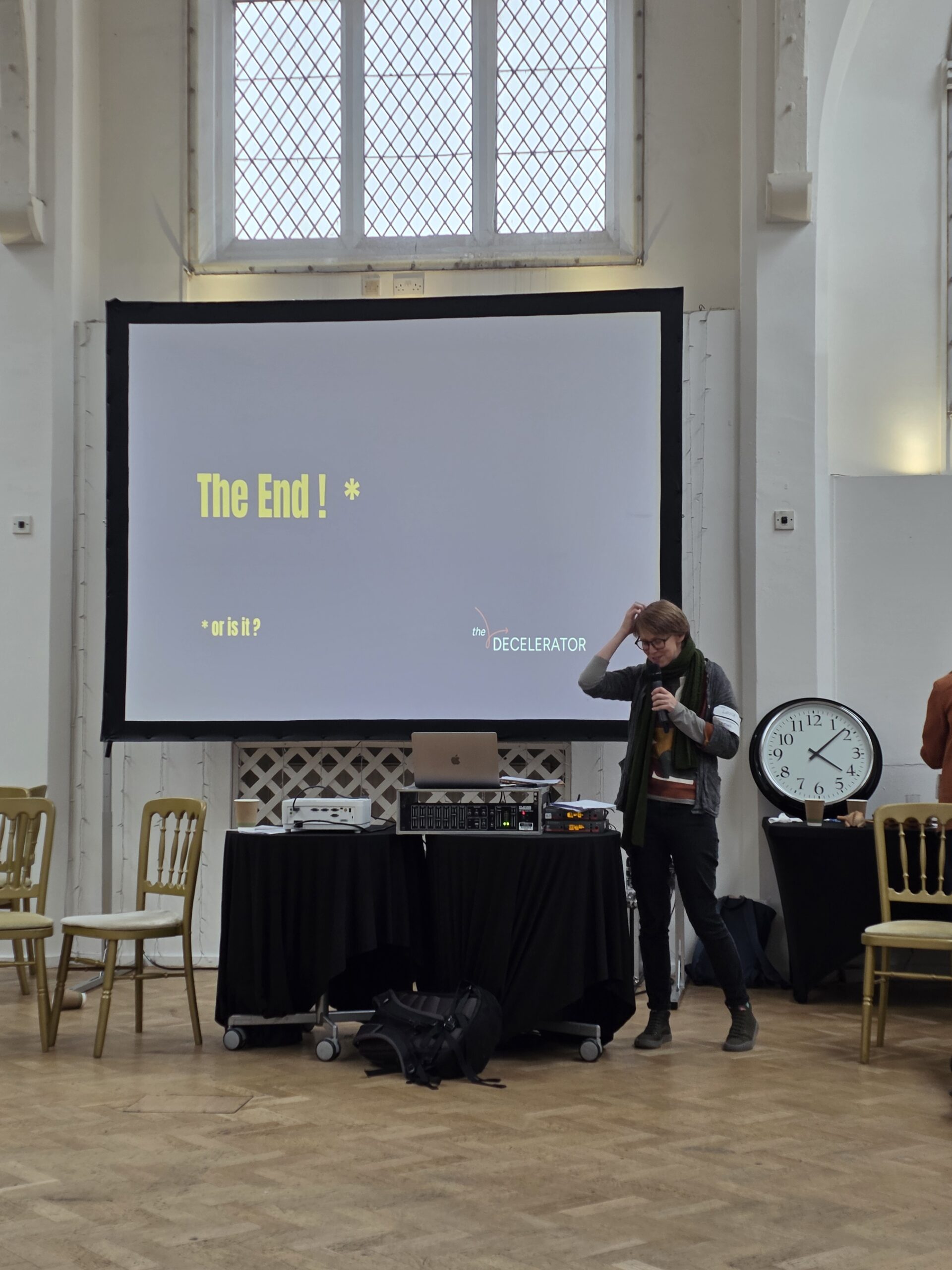
    The conference itself was held in the Old Library, a beautiful (if drafty), refurbished, old building that I imagine used to — per its name — be a library. After some brief icebreakers, we were joined by two marvelous speakers from the adjacent field of grief and funereal care. Then after lunch, we did smaller group sessions focused on themes and tools.

    My brain is still buzzing with what I heard and I am touched with how raw and honest the conversations were, even over some tricky social and cultural divides. However, I’ve boiled my thoughts down into 4 main takeaways:

    Community Building Matters

    I went into this event thinking that I wanted to maybe wind down the community of practice. The work is no longer being funded and sometimes it feels like there is only a trickle of engagement in the Slack or at the gatherings. However, the feeling I got from the assembly is that gathering is so very important, community is so important. People need a place for sharing resources, job opportunities, challenges, and even epiphanies with each other.

    The Decelerator folks have a large reach but I, sadly, don’t see them building community beyond this conference. How can we bridge the gap? I’m trying to nudge them a bit, but I am also open to what else can be done to meet the obvious need. I still do very much called to be a convener and connector in this space. Someone give me the money to keep doing it, please!

    “The feeling I got from the assembly is that gathering is so very important, community is so important. People need a place for sharing resources, job opportunities, challenges, and even epiphanies with each other.”

    Endings – Professional vs. Practice?

    I also came away wondering whether this needs to be consultant work. The lion’s share of the attendees were independent consultants (as am I) and I came away so curious how people were sustaining themselves and whether many of us were just competing over ever-shrinking pots of funding. I also wondered whether coming in as strangers for what should be deeply relational work was the way to approach this.

    Should endings, succession planning, transition management ultimately be skillsets and toolboxes held by operational leaders or should outside specialists be marched or is it a both/and? I fully recognize the valued of shaking up the energy by bringing in the occasional outside facilitator, but should the intimate work of closure be held by such an outside entity? I am not so sure.

    Thriving and Surviving while Ending

    This takeaway is, again, brought to you by my deep concern and suspicion of consultant work. I’m concerned about the sustainability of this work if the people doing it are not well taken care of. I’m feeling it deeply for myself right now, not only financially but also interpersonally. I’d love to have more vulnerable and brave conversations about mutual aid and community care. This can’t just be work people do because they have a spouse with a stable job or have otherwise lucked out financially. Too many valuable voices and talents will be left out if we stay such a narrow group.

    One of the things that struck me so deeply was when grief influencer Amber Jeffrey shared that she felt lonely in her work. This is also real. There is a conversation about coming and staying out of isolation when we are doing such tender work. I know The Decelerator has a supervisor to hold them through their challenges. We need to keep exploring such models.

    Amber Jeffrey and Poppy Mardall sharing sage lessons from the grief and death care community
    Amber Jeffrey and Poppy Mardall sharing sage lessons from the grief and death care community

    Rooted in Faith, Spirituality, Culture

    My particular practice is rooted in my own spirituality, my cultural traditions, and other cultural traditions that I try to respectfully adapt to meet the needs of the communities I work with. I came away from the gathering interested in connecting with more people who are interested in or actively elevating the role of ritual in endings.

    Thanks again to The Decelerator Team for organizing a great assembly and big thanks to the city of Birmingham for being so dang charming. I am super smitten!

  • Me! In NonProfit Quarterly!

    Me! In NonProfit Quarterly!

    I have long had ‘Publish a piece in NonProfit Quarterly’ on my bucket list. Even before I started The Wind Down, I felt myself drawn to this fantastic publication and the work of its many editors, and I wanted to be part of the conversation!

    So, it was a great honor when I was contacted by one of its editors — a lovely person, who I happened meet and work with over 25 years ago! — to say a few words about the art, science, and magick of closing things down.

    You can click here to read my article, and I thank you if you do. Lemme know what you think.

    Here’s to dreams coming true!

  • Tending to Endings at Practices for Composting and Hospicing

    Tending to Endings at Practices for Composting and Hospicing

    Since April 2024, I have been the facilitator of the Practices of Composting and Hospicing community. Next month, we will be joined by the team behind the Tending To Endings card deck, a tool to help groups and individuals design and have better endings. The cards are inspired by concepts from nature and are absolutely beautiful and inspired.

    Curious?

    Join us!

  • How You Made Them Feel OR “Cruelty Over Care In Closure”

    How You Made Them Feel OR “Cruelty Over Care In Closure”

    These past few weeks have been rife with the abrupt shuttering of government programs, firings of thousands of government and nonprofit employees, and the long tail. knock-on effect on everyone from aid program employees to dock workers and rural farmers. The topic of endings has been front of mind across the globe, so people have been reaching out to basically say, “Wow, everything is closing! This must be your moment!”

    It is so very much NOT my moment.

    This is basically everything I don’t ever want to see happen. Cruel, callous ejections of people that THE WORLD STILL NEEDS — all while we have more than enough money to keep them working — is nothing like what I prescribe or want to occur.

    Now, don’t get me wrong. I am a person who stands very far to the left — miles away from the left of the left of congressional chambers, and no great fan of the state or representative of representative democracies. But you know what I detest more than any of that? EVIL. My opposition to humans bringing misery to other humans or the planet solely for their financial and political gain (or because they think it is a fun game!) is at the heart of my political convictions and also at the heart of the work I am continuing to develop here at The Wind Down.

    In a previous post, I wrote about what is lost when things close down poorly. Just to recap, that list includes:

    • knowledge loss
    • breakdown of relationships – external and internal
    • reputational damage
    • leaving a service vacuum
    • loss of breadcrumbs/traceability back to the work you did and the people that did it.

    In yet another post, I also wrote about reasons why projects and organizations close. Having to close suddenly usually happens when an organization suddenly runs out of money, finds itself in a dangerous situation such as an actual warzone, or when the/their work finds itself in say a hailstorm of controversy. While the institutions are under attack, I’d say it’s not quite the same as a warzone situation. An artificial warzone has been created, which, ironically, is now endangering the lives and well-being of many people in actual zones of war, disease, and famine and likely contributing to their increase.

    Needless to say, these closures represent the kind that are not prominent on my BINGO card. It is just about the nightmare scenario of total failure and loss, and the consequences are likely to reverberate for years — if not decades — to come.

    “I’ve learned that people will forget what you said, people will forget what you did, but people will never forget how you made them feel.” – Maya Angelou

    So what do I recommend when you are in the absolute worst case closure?

    Well, first of all, let me say that I am IN NO WAY implying that the people in this situation have any responsibility to do anything more, this is just if people are at loose ends and want to explore how to maybe make a splash of lemonade out of lemons. Feel free to do nothing but plot revenge, if you wish. Lord knows these devils deserve it. But for anyone who wants to continue on with me and this thought experiment. Here are a few ideas*:

    SCENARIO 1: THINGS ARE BAD, BUT YOU STILL HAVE YOUR JOB.

    If you can, back up contacts, important (non-proprietary) documents, and start taking some of your desk stuff (if you work onsite) home. Also, I know a lot of people end up using the work computer as the personal computer, but if they demand you give it back you will lose a lot. So, look into getting your own device or backing up bookmarks and whatever else you need to the cloud. Get phone numbers of some of your co-workers and give them yours.

    Ask around for names of labor lawyers now just in case. If you can get a free consult just so you know your rights, take it!

    SCENARIO 2: THINGS ARE BAD, AND YOU’VE BEEN TOLD YOU MAY SOON BE LET GO.

    See above and do everything listed there. Take home EVERYTHING (if you work onsite). Wipe your computer of anything personal NOW.

    SCENARIO 3: YOU’VE BEEN LET GO BUT THE ORGANIZATION IS STILL OPEN

    If you weren’t able to get your physical things, first try to reach out officially to see if they can put your things in the mail. It sucks because they may miss stuff, but it can be better than nothing. If they refuse, you can see about getting a lawyer to write an official letter. If you can, hold off on signing your separation paperwork until you got your property returned.

    As for documents, you might try reaching out to a trusted co-worker via phone, email, or LinkedIn. DO NOT write them on work email. You might jeopardize their job and make things worse for both of you. If that person can safelyget documents to you, they should download and send via a non-email address. Sharing via GDRive or some other work system is NOT THE MOVE.


    SCENARIO 4: YOU’VE BEEN LET GO, EVERYONE WAS LET GO, AND THE WHOLE ORG IS CLOSED.

    Find the others and get creative. If there is legal action you can take, take it! I particularly love that the former employees of (now-shuttered) 18F swarmed on a website the day they were fired and had it stood up in under 4 hours.

    The other day, I attended a really beautiful, early morning, grief circle hosted by Fearless Project for people that worked with and through USAID. It was valuable for people to just see each other and not feel alone. I heard so much confusion, loss, fear, grief, love, and resilience. People are disappointed and heartbroken, but no one was talking about giving up or going corporate. However, I was moved by how much they still wanna find a way to do the do-goodery stuff that drew them to charity and public service.

    The new 18F website created by former staffers

    What did I miss? What have you seen that has been effective in salvaging a bad ending?? Lemme know in the comments!!

    *GIANT DISCLAIMER: I am not a lawyer. None of this is legal advice. I HIGHLY recommend you get a lawyer if you are in a bad situation in any organization. Lawyers have saved my professional bacon many times, and I can’t suggest enough that you work with them when things get (or even feel!) bad.

  • Me on the Leaving Well Podcast!

    Me on the Leaving Well Podcast!

    I was honored to speak with my dear pal Naomi Hattaway on her fantastic Leaving Well podcast. It’s relatively short and I hope you will listen! The link is here, and it is available on ALL the places where one can find podcasts.

  • Twists and Turns From Year One of Winding Down

    Twists and Turns From Year One of Winding Down

    I did not expect to be here at the end of the year. At the beginning of this year, I had (yes) purchased this domain and (yes) set up this website and (also yes) started offering the hotline. However, in the back of mind I figured I would end up back at a tech job, and this whole thing would be something I’d maybe do in my free time on evenings and weekends. Instead, I am here in December having spent the whole year working almost entirely on growing this business.

    Before the year is out, I wanted to share a little of what I have learned, what I have achieved, what I have struggled with, and also show gratitude for the people that have showed me a lot of care and support over this very unanticipated year.

    Listening Is The Main Thing

    Product-Market Fit unlocked! People understand and value what I am offering. I have talked to a LOT of new people this year and everyone I talk to immediately understands the value of making endings better, hospicing what isn’t working, and gathering up the learnings and skills and people to nurture whatever comes next.

    The free “hotline” calls started out as a way to validate my idea while also exploring how I could be of help to people in the sort of mission-driven organizations I would like to service. I have been bowled over by people’s willingness to be extremely raw and honest with me about their closure journey, and they have been grateful for someone neutral and non-judgmental to lend a listening ear. For those who don’t know me personally, I can be a bit of a chatterbox, so these calls have been an opportunity to train deeper listening and just be present.

    People aren’t looking for me to fix things or offer solutions or point out silver linings, they mostly just want to be heard. Many times people have told me that the “nuts and bolts” of shutting down are “the easy part”; they reach out to me — a total stranger! — because they don’t have anywhere to go with all the feelings, anxieties, regrets, resentments and sometimes even sighs of relief that might be kicking up. Sure, if I can point out some things they might want to consider, all the better, but the listening is the thing.

      The Field Doesn’t Have This Figured Out

      Part of my hope in starting The Wind Down was that I would find out if anybody else had the challenge of “delivering better organizational endings” all figured out. Over the year, primarily through facilitating the Compost and Hospicing community of practice, I have been blessed to connect with so many BRILLIANT souls who all have one piece of the puzzle, but I — so far — only have a few peers who are holding civil society closures as their actual work day in and day out, and the great majority of them are across the pond in the UK rather than here in the US.

      I’ve even had conversations with seasoned folks who’ve spent their entire careers in civil society and here they are asking little old me for suggestions and advice! This is all mostly unexcavated terrain! No one really knows much of anything! We are all slowly fashioning it together!

      As political and socioeconomic climates continue their twists and turns alongside (and even hastening!) environmental collapse, I can only imagine this work becoming more urgent and hopefully better funded. As Ginie Servant-Miklos says in her new book Pedagogies of Collapse,

      “This leaves us with two alternatives, in my view: deliberately dismantle thermo-industrial civilization now or let it collapse in an uncontrolled manner later. The temporal distance between the two choices is probably only a matter of one or two decades…The reason we are advocating for controlled degrowth is because the alternatives are much, much worse.” – Ginie Servant-Miklos

      Sunsetting At Scale

      I started the year thinking I might eventually want to work one-to-one with nonprofit teams who are in the process of closing, but the more I connected with leaders carrying out and/or contemplating closure, the more I began to feel like the real work is to work with groups of groups, speak at conferences, engage social enterprise incubators and accelerators, and maybe even write a book?

      I am not saying I would flat-out refuse to work directly with just one group, but the issue feels urgent and one-to-one feels too slow. Some days, I feel like I want to run out and stop people before they start again! Or at least warn them to not get starry eyed about “new shiny”.

      As Lee Vinsel and Andy Russell said in their pivotal Aeon article Hail The Maintainers

      “In formal economic terms, ‘innovation’ involves the diffusion of new things and practices. The term is completely agnostic about whether these things and practices are good. Crack cocaine, for example, was a highly innovative product in the 1980s, which involved a great deal of entrepreneurship (called ‘dealing’) and generated lots of revenue. Innovation! Entrepreneurship! Perhaps this point is cynical, but it draws our attention to a perverse reality: contemporary discourse treats innovation as a positive value in itself, when it is not.” – Lee Vinsel and Andy Russell

      Ushering The New AND The Old

      When I threw myself into this work, I just sorta blanketed the spaces where my various communities hang out. Mailing lists, Slacks, Mastodon, LinkedIn, and also lots of random, cold emails to people who I admired and hoped I could talk to. I have been bowled over by how responsive so many total strangers were.

      I have meet soooooo many super fantabulous people this year; some have become actual factual friends, while others who have just kept incessantly bringing my name up to people in conversations. Along the way, I have also had to (in true Wind Down-fashion) close some doors. Since I spent the first quarter of the year thinking I was going back to work in tech, I was juggling a lot of identities and jumping back and forth over a pretty “high fence”, but once I decided The Wind Down is what I do now, I knew I had to duck out of my “old life”. It was with a heavy heart that I logged out of some of those Slacks and unsubscribed from a bunch of those mailing lists. I also unfollowed many, many old tech colleagues and replaced them with people who were working in facilitation or in the impact space or at foundations. I also — just last week — loaded up over a decade’s worth of books I’d collected from my old field and put them, on-by-one in a local free library box down the street. I hope other people enjoy them! I now have space on my shelf for all the nerdy books I have on death and endings, ha!

      I was going to start naming the names of the people I am grateful to/for here, but I am afraid I will forget someone and start kicking myself. I feel like the real ones all know and have been profusely thanked. The one thing I will mention is that I am a member of IMMA Collective, a global community of mission-driven solopreneurs and they have been in my corner all year long. They are the people I go to first with all my challenges, frustrations, confusion, and wins. It has so amazing to be building my own business but not even for a second feel alone. Thanks to Lilli and everyone who makes IMMA IMMA. #fuckitmode !

    1. Practices for Transitions in a Time Between Worlds

      Practices for Transitions in a Time Between Worlds

      As part of my work facilitating the Practices of Composting and Hospicing community under the umbrellas of Stewarding Loss and the Joseph Rowntree Foundation’s Emerging Futures Initiative, I was invited to participate in this collection of writings from amazing facilitators and world builders.

      My piece is here and the entire edition is available to download.

    2. Towards Your “Tombstone Site”

      Towards Your “Tombstone Site”

      As part of my work developing The Wind Down, I have been bookmarking the websites of sunset nonprofits for the past few years. As my list grew, someone suggested that maybe we needed a “museum of closed nonprofits“, (hat tip, Kyle Soo) so I went ahead and created one. And then a few months after that, I started my newsletter Closing Remarks where I cover all sorts of pauses and endings in the public sector.

      Although a news article or an email from a friend often alerts me to the impending closure, I often have to visit the organization’s website to gather details that help me color the story. As such, I have perused the websites of hundreds — if not thousands! — of shuttered and shuttering civil society organizations.

      Even when an organization is open and in good health, a website often has so much work to do. It needs to be a place to share your message, collect donations, entice funders, spread news, attract job candidates, and often much more. While a well-funded and growing group can often turn to a professional to craft their messaging and build their website, the work and language of drawing that work to a close in a meaningful way usually requires a slightly different mindset and skillset. No more is the focus on search engine optimization and flashy graphics, now the site needs to be a time capsule, a signpost, and a monument.

      In my travels across the internet of wound-down, well-meaning organizations, a checklist has begun to form in my head of critical elements that need to be added, removed, or finalized on a website before the lights go out. My hope is that these building blocks can help you erect a tombstone site that you can be proud of for years to come.

      Share your timeline

      Why did your group start and when? Inquiring minds want to know! With the cessation of your operations, your About page really should be a History page instead, outlining the when, how, and what of your organization. This is your time to brag about your accomplishments! Not only will this be informative for curious souls like me, but it can also be a resource for your former employees who might be able to share the information there as they look for their next roles.

      One foundation that did a beautiful of sharing its history is the Kendeda Fund; their “visual garden” features numerous highlights from its 30 years of giving.

      Tell your ending story

      You will also want to add information about why you decided to shut down, what went into the decision, and maybe any advice or valuable learnings for groups that might find themselves in a similar situation. By being as transparent as you can about the wind down, you:

      • ward against rampant gossip and hearsay;
      • work to protect the reputation of past collaborators; and
      • help to secure your legacy;
      • and pave the way for those who will pick up this mission in the future.

      The 2024 conclusion of the annual Allied Media Conference was preceded by two “in chryalis” years of pause followed by one final conference and a loving writeup of why the Allied Media collective decided now was the time to end it.

      Put up critical signposts

      If your group provides services to a public that is likely to be somewhat left in the lurch by your disappearance, you should also do your best to point people in the direction of organizations who they can turn to, to fill the gap. You will, of course, need to try and make sure those other agencies and/or nonprofits have the capacity to help by connecting with them to let them know the situation. You certainly don’t want to overwhelm another group who might already be on the ropes, but trying to provide a soft landing for those that relied on you goes a long way to protect your reputation and abide by your mission until the very end.

      When the administrators of The College of St. Rose in Albany, New York realized they would have to cease operations after nearly 80 years, they realized that the first order of business was ensuring the well-being of current and past students. They created and shared a “Teach Out Plan” to help everyone understand the timeline and their options for either transferring to a new university or obtaining important records that they might need in order to pursue future work and/or educational opportunities.

      Secure your archives

      Over the life of your work, you will likely generate many resources, reports, and tools that could be helpful to whoever comes along to drive forward the mission. As part of the effort to “tombstone” your website, you will want to think about how and where you might want to organize and place these digital resources so others can get their hands on them.

      As activist collective The Rules worked to put a bow on their efforts with meticulous archiving of all their resources, they decided to upload their open source “culture hacking” tools to public code-sharing site GitHub so that others could use and improve.

      The Rules gets bonus points for putting those tools up in a more public place than their website so they are protected against the possibility of their own website going down. Websites going down because of unpaid web hosting bills is a sad but true fact of nonprofit endings.

      …..and also remember to:

      • tell an expansive story – If possible, reach out to as many former stakeholders as possible. Explore how their voices can be included in the final story of the organization.
      • cease submissions – if you have been soliciting mailing list signups, donations or anything else. Please remove and disable all such buttons and forms. If you wish, you might encourage people to donate to partner organizations.
      • update all your channels -Don’t just update your website, please make sure your physical location, your voicemail, and all your social media channels make it clear that you are closed. Too often, I encounter organizations that have a decent tombstone site but still have Facebook pages or Instagram profiles that on first glance make it look like they are still active.
      • pay your bills and make a plan – This is a tricky one, but — if you can — pay to keep your website up for a meaningful, agreed-upon period of time before your bank accounts are closed. You will also want to decide whether you want to let it die after that or if you can find some other way for the most valuable/valued aspects to be preserved. Whatever you decide, make sure it is communicated!

      While this likely won’t be easy, when done with time and care, turning your site into a tribute to the work you did can be transformative and healing. As each team member contributes to finalizing the website, you can move closer to crafting a narrative that will be valuable to many in the future.

      If your organization needs support building your tombstone site or simply supporting you through a closure, don’t hesitate to reach out!

    3. Signalling A Pause

      Signalling A Pause

      In talking to people on the hotline, I meet them where they are in their closing journey. While some of them are certain they are closing, others are entering a period of deep discernment around the future of the group. When I hear a large amount of uncertainty, I will often suggest that they consider the possibility of pausing operations.

      Pausing operations can give the organization time to:

      • give the staff, board, volunteers, members time to address symptoms and causes of burnout;
      • talk to funders about the situation;
      • connect with partners about your challenges; and
      • assess the impact of your organization’s (temporary) absence from the ecosystem.

      Examples of Responsible Pauses

      Over the years, I’ve collected a few examples of inspirational nonprofit pauses. Here are a few I really like.

      Allied Media Conference’s Year of Chrysalis

      In 2018, Allied Media Conference decided to take a year (2019) off to think about how they wanted to move forward after 20 years of operation. As part of the “chrysalis” period, they decided the conference would shift from annual to biannual. 2020 was the first virtual conference, with 2022 marking the final gathering.

      In 2023, the parent organization Allied Media Projects announced that the conference would be sunsetting.

      New Constellations’ Pause

      New Constellations is a time-bound global initiative to support transformative community building. They announced their pause in 2024 after five years of operation.

      SAALT’s Year of Chrysalis

      South Asian Americans Leading Together (SAALT) announced a pause in late 2023. The group offers programs to support new immigrants, gather South Asian American leaders, and develop youth leadership. Their focus during this time of discernment is to try and tackle caste-ism in their ranks.

      Elements of A Responsible Pause

      While every pause is unique to the group and context, there are a few elements that make for a considered and successful pause period. Here are the aspects I have observed.

      Structure the Pause

      Determine Operations Level

      Before you declare that you are in an organizational pause, you will need to define what pause will actually mean for your group. It can vary depending on the size of your organizations and the nature of you current commitments.

      At Allied Media, their pause period did not mean bringing all operations to a stopping point. They operate as funders, facilitators, and fiscal sponsors, and that work needed to go on.

      In another case, a community nonprofit noted that a possible pause could mean simply letting the existing programs, which were in partnership with a local school, run through the end of the school year and then not renew for the coming school year.

      Your team will need to decide what can be stopped completely, keep running at a low hum, or remain functioning “as normal”.

      Plan Some Activities

      You will also need to develop arough outline of what you want to actually do during this time. Will you do a staff or board retreat? Will you have strategic board meetings?

      You should consider connecting with a facilitator to explore how they might hold space for your group to have these necessary tough discussions. While the executive director or board president may be the person that normally facilitates gatherings, bringing in outside help gives them the permission to put their energy into group in a new and necessary way.

      The pause is also a good time to consult with your funders and strategic partners. These people could have useful guidance for you, and in some cases, strategic partners might be able to help take over some of your programming or even be able to facilitate a merger or acquisition.

      Set A Timeline

      In addition to agreeing on how much to tune down operations and what you want to do during this time, you will also want to time-box your pause. It important to give yourself a reasonable deadline to make decisions. Aim to set a timeline that is sufficient to accomplish the tasks you laid out in the previous step with a little padding to accommodate the normal rhythms of life.

      Communicate the Pause

      Once you’ve determined the rough outlines of your pause, you need to let everyone know what is going on. In many communities, word travels fast so it’s important to make sure that internal people know fairly early on and don’t feel blindsided. You also need to communicate this shift to your fundraisers, your partners, and the greater public. Make sure to put a notice and explainer on your website and any social media your organization uses.

      Note: You don’t have to use the word “chrysalis”!

      Reporting Back

      During and after your break, sharing what is going on/ went on can help foster transparency and trust within your community and the larger ecosystem. The challenges your organization is facing are likely not unique to you, and the lessons you learn can offer up a path forward to others who are facing similar situations. Update your blog and social media to let everyone know what’s up!

      After Allied Media ended its chrysalis year, it shared its takeaways in several places, and it even cited conversations from the chrysalis year when they decided to transition their executive director two years later.

      Take Action

      Finally, after you’ve exited your own organization’s “cocoon”, it will be time to embark on actions to either spin back up operations to the new level, make staffing changes, articulate a new mission, or shift your focus to winding down operations. While you will have reported back via public channels, the same people who you communicated the pause to will also need to be informed of what the plan and direction will be moving forward.

      When Pausing Is Not The Answer

      While there is power in the pause, it is important to note that the pause is not a time of inaction, it is a time of active inventory and introspection. You will need to be available to meet, assess, brainstorm, and have deeply honest conversations about where you are now, how you got there, and possible paths forward.

      If you don’t have a critical core of people on board to do this, it might be a sign that a considered closure is a better way forward. Saying “paused” when you mean “closed” can cause confusion and engender mistrust amongst your funders, partners, and the community you serve.

      If there is only a little bit of gas left in the tank, I’ve found that it is better used to give the organization a respectful sunset. Using those final pushes to tie up loose ends, can ensure that you leave behind an honorable legacy and useful breadcrumbs for whoever picks up the work in the future.

      (For more on this topic, check out the article “Permission To Pause” by The (now-defunct) Whitman Institute)

    4. Announcing the Closing Remarks Newsletter

      Announcing the Closing Remarks Newsletter

      Hi friends! I started a newsletter. It’s called Closing Remarks and it’s gonna be a semi-regular (maybe twice a month?) roundup of links related to non-profit closures and the assumed connection between longevity and impact.

      You can see the first issue and sign up for it below or here.

    5. A Good Day To Die: Some Reasons To Call It Quits

      A Good Day To Die: Some Reasons To Call It Quits

      One of the major goals of The Wind Down is to help shift the discourse around non-profit endings so that the immediate assumption isn’t that the organization or project closure is the result of loss or failure. Not only is it too often the case that outsiders hold this belief, sometimes people inside the organization are guilty of it too. People will dissuade themselves from even considering closing because things are “going well”.

      The truth of the matter is that there are all sorts of reasons for an organization to stop existing, and the more people know about them, witness them, or take part in them, the more they can (hopefully!) move away from a knee-jerk negative reaction to sunsets. Here are a few reasons I’ve come across along the way.

      SUCCESS!

      This might be my favorite closure reason. If an organization accomplished what they set out to accomplish and can neatly close down, what a win for everyone! One of my favorite examples of this is the We Charge Genocide campaign that ran from 2014-2016 in Chicago. Inspired by the 1951 We Charge Genocide petition to the United Nations, they were able to raise funds to send 8 young Chicagoans to Geneva to charge genocide against the United States for protracted police violence.

      Upon return they created an informative report and organized in their communities for a short time before slowly winding down in 2016. They came to charge genocide, they did, and then they stopped!

      Another fantastic example is the WaterSHED project, which was created as a 10-year initiative to help expand access to clean water in Cambodia. The goal from the outset was to support capacity-building on the ground and then leave. And despite many challenges , they left when they said they would. WIN! (Seriously, read former-ED Geoff Revell’s article about it. It’s so good.)

      SHAPE AND/OR PROXIMITY

      Social change work is not one size fits all. If the organization is too small or too big to do the work, it might be time to either change shape or shut down. In addition, sometimes an organization — or an organization’s headquarters — are too far away from where the service is needed or can best be delivered. One example that relates well to this is EveryChild’s closure.

      EveryChild was a UK international development charity formed in 2001 that operated field offices in Eastern Europe and the developing world. In 2011, the organization intiated a series of strategic changes that devolved power to local agencies and eventually resulted in the creation of a new international alliance, Family for Every Child. Thus the decision was taken to close EveryChild and all its field offices from the period between 2013 and 2016, and leave the work to the people who could more effectively make an impact in the lives of the children and families they wished to support.

      “Concerns about lack of sustainability may be financial (loss of funding or a growing cost base), a loss of key people (staff, volunteers or trustees), a lack of shared direction, recognition that others doing similar things, there are duplications or inefficiencies, or a growing concern that your work is no longer viable or relevant in a changing wider context.”

      Sensing An Ending: A Toolkit for Nonprofit Leaders to help decide, design and deliver better organisational endings by the Stewarding Loss Collective

      OBSOLESCENCE

      Adjacent (and maybe overlapping?) with success is the idea that the organization just isn’t needed or won’t work anymore. Many initiatives and groups in the civil society space are started with the humble vision of “working themselves out of a job”. Sometimes this happens! And then sometimes the situation on the ground just changes. In this 1999 Guardian article, the writers outline how war in former Yugoslavia quickly put an end to a flourishing network of NGOs committed to growing civic society in the wake of political change. In the blink of an eye, the terrain changed and the groups could no longer function as the vision of a free and flowering Yugoslavia was no longer viable.

      LEADERSHIP

      Many organizations grow out of the vision of a single inspired leader or group of leaders. Oftentimes when a founder or team of founders decide to step away, they can leave shoes entirely too big to fill. Sometimes it isn’t necessarily the founder, but just a really strong leader who the board struggles or is unable to replace. Stories of such transitions can be found on Naomi Hattaway’s excellent Leaving Well podcast.

      DISCHORD

      So now we are getting into some of the stickier ones. Organizational dischord is certainly at the heart of some pretty epic closures. Conflicts and the inability to functionally tackle them are a big part of what led me to start asking whether these endings could happen better than I’d seen them happen.

      One well-documented and notable example of such an ending was UK-charity Campaign Bootcamp’s sunset, which was sparked by difficult and, ultimately, irreconcilable issues around race, class, privilege and power. Campaign Bootcamp, an organization that had been a darling of the UK charity sector was formed to support people in gaining the skills they needed to launch successful campaigns for social change. However, when the change that needed to happen was “inside the house”, the leadership was unable to reach an equitable and just resolution.

      MONEY

      Lack of funds is very often a reason that an NGO will shutter its doors. Whether it is a lack of foundation funds, money from individual donors, or tuition related to enrollment (a challenge facing many US universities as of late), cash-strapped organizations struggle to meet the needs of their employees, partners, and the communities they aim to serve. Low funds and inability to cover costs are extremely valid reasons to close up shop.

      In a future post, I plan to cover how this sort of ending might be managed, particularly from a fundraising and fundraiser’s perspective.

      STAFF

      An organization is only as good as its people and if you can’t hire and retain capable people to do the work, you will struggle to fulfill your mission and realize your vision. Non-profit staff members are frequently overworked, underpaid, and highly prone to burnout. While many non-profits profess lofty values of care, far too often they fail to realize them in their employment practices.

      Even when your organization does offer great benefits and a manageable workload, competition for talented workers can be challenging when competing with opportunities in government and private sector. If your group or initiative can’t offer the sort of salaries and/or job security those others can you may struggle to hire the people you need, attract good volunteers, and/or build the capacity to drive forward your mission.


      This by no means an exhaustive list. What other reasons have you seen for NGOs to die? Lemme know in the comments!

    6. What To Say (And Not Say!) When A Person Is Going Through A Non-Profit Closure

      What To Say (And Not Say!) When A Person Is Going Through A Non-Profit Closure

      Though closures of projects in the civil society/non-profit space are nothing new, it still can be a bit tricky to know how to be supportive and show empathy when someone is going through this life-changing experience. A few friends of mine recently went through personal tragedies and as I was thinking about how best to be there for them I got to thinking about how we might show up better for people going through organizational endings.

      Some Less-Than-Helpful Personas


      THE DETECTIVE

      People often assume an organizational closure is the result of some big failure , blowup, or catastrophe. The thinking is often that there is some salacious story or else some agonizing tale of woe that caused the organization to come crashing down. However, the truth is that lots of groups close for mundane reasons and some even close intentionally and triumphantly (see the story of WaterSHED’s closing as one example).

      Rather than getting into the details of the organization, why not meet your friend where they are and check into what is coming up for them. Do they have any immediate needs that you can assist with? Are there any milestones coming up where you might be able to check in with them? Mark your calendar and set reminders to be there for your friend and colleague when and where they actually need you.

      THE NEWSHOUND

      The non-profit funding landscape is tricky and getting trickier every day, but you know who likely knows that best? Your friends working at non-profits. Bringing up articles you read about how things in their industry or area of focus are “particularly bad”, is not really going to be useful when they are already face to face with the end.

      Part of what lead to the organization’s demise is likely to be related to lack of support from funders and other stakeholders and was often painfully out of their control. Mentioning macro trends when someone is facing an urgent and acute issue smacks of blaming the victim.

      THE CONSOLER

      NGOs close in so many ways and for so many reasons. In the short time, I have been talking to people about these endings, I have heard stories ranging from the disastrous to the positively jubilant. So when you hear someone’s organization is closing, you don’t need to immediately need to go into condolence mode. Even in the disaster situations there may be people who are excited and eager to move in, and, similarly, even a well-planned, intentional program or project end can have its rough edges. When faced with news of a shutdown, be neutral, polite, and curious.

      THE SILVER LINER

      An organizational closure can bring up a lot of emotions, even when the ending is mostly positive. So it is better not to try and put a “silver lining” on it. Mentioning to the person going through the organization closure that at least they “won’t have to deal with [INSERT ANNOYING COWORKER NAME HERE} anymore” is not particularly helpful. If they bring it up, it is fine to agree with them, but it’s not the most helpful thing to try to put a positive spin on the situation if your friend is not feeling particularly positive about it.

      THE POLLYANNA

      Similarly, you don’t have to try and reassure the person that something better is going to come along. Life is long and mysterious and we don’t know what is going to come next. While it is good to be supportive and hopeful about the future, if the person you are dealing with doesn’t feel like anything good is on the horizon, allow them the space to sit with that feeling rather than trying to divert them because you are uncomfortable with the situation.

      If you find you aren’t able to hold space for the big feelings that your friend is holding, you can certainly send this website along to your friend and let them know I also offer free closure calls to people closing or in discernment around closures. I’ve been through it, and I am happy to be a listening pair of ears!

      Some Helpful Personas

      THE GRATEFUL

      The person or people who are facing down the end are likely struggling with feelings of regret about what they didn’t do or grief for the dreams and goals they weren’t able to achieve. Whether they were part of the founding team or a later addition, people who often pay the “passion tax” to join a mission-driven organization are looking to come away with a feeling that they are making a genuine impact on the planet. When their organization must close — usually due to no fault of an individual employee — that sense of purpose is abruptly wrenched from them.

      Why not be the one who reminds them of all the good they were able to achieve during their time in operation? Thank them for their service and remind them that, no matter how long they existed, they did make a valuable contribution. When possible, find examples of other people thanking them for their work and let them know there is likely still more time for them to be of service on the planet.

      THE HELPFUL

      The ending of any type of project or enterprise is full of various loose ends (no pun intended!) that need to be tied-up. As the final days of an organization draw near, it is often the case that there are fewer and fewer people around to sort out the crucial tasks necessary to completely close out. Why not offer a helping hand? Even if there is nothing specific for you to do, sometimes just being present and bearing witness is enough.

      Worries for the future coupled with sadness about the past and present can easily cloud the mind and make it hard for your friends facing closure to focus. Sometimes just being a body double is enough to lift people’s spirits, shake feelings of isolation, and assist in getting them on track.

      Alternatively, your friend/colleague may just want someone to distract them from what is going on. Whether that person is generally relieved or even happy the organization is closing or if they are feeling woeful, they may find that the work of shuttering the organization is just occupying too much of their mental space. Take them out for a drink or invite them to a movie to get their mind off work.

      THE EMPATHETIC

      Finally, if you’ve been through a closure of your own, do share about it. So many organizations shutter every year (see our Museum of Closed NGOs for some!), and the more we talk about these organizational endings, the more we can normalize the idea that nothing lasts forever and good things can come from people gently releasing their work back into the wilds.

      In addition to the free hotline I offer, I also have some self-assessment questions that I suggest people go through with a friend or colleague. You can be that friend or colleague!

    7. What I’m Doing – April 2024

      What I’m Doing – April 2024

      These last few months of building this practice have been some of the most satisfying of my life. With every passing networking call, I feel a stronger sense that what I am doing is needed, and every closure hotline call fills me up with an almost-overwhelming sense of purpose.

      The other day, as another hotline call was coming a close, I asked the person if they had any questions for me and they blurted out, “So, what are you doing?”

      She was not the first person to ask this and certainly won’t be the last, so I figured I had better write this up in the hope that it would clear things up for people — and maybe also (a little bit!) for me.

      Hotline Help

      According to Wikipedia, the idea of a hotline or helpline originated in the early 1950s in the UK as a means for trained, caring volunteers to be available to people who may be in the midst of a crisis. Since that time they have spread around the world to address such pressing issues as suicidal ideation, assault, and drug overdose*.

      I came to the idea of offering a “closure hotline” from my friends/collaborators at Stewarding Loss and The Decelerator who have been offering this service to organizations facing closure in the UK for over 5 years now. My hope was that I could use it as a way to: (1) determine whether what I was doing even made sense, (2) start to train myself in deep listening, (3) start to identify patterns in organizational endings, and last but not least, (4) hopefully say or offer something that might help someone else who is struggling with a closure.

      Unlike a traditional helpline, I am not here to stop anything from happening. I am, in fact, only attending to discussions of people actually looking at endings. If people are trying to figure out how to save things, I tell them something akin to “come back when you think you are ready to die.”

      My role, then, is to listen deeply, probe carefully, and reflect the person and their situation back to them in a way that — I hope! — gives them valuable perspective. So far the response has been deep appreciation.

      “So, what are you doing?”

      Finding The Others

      In addition to speaking with people in the throws of closure, I am also chatting with people about endings gone by and also practices of winding down. Some of the fascinating people I have recently met include:

      • Anna Shneiderman, who has been facilitating theater closures in California’s Bay Area;
      • Erin Richardson, who supports organizations in the process of removing items from museum collections; and
      • Naomi Hattaway,who is helping people design their departures from organizations.

      I have also been fortunate enough to be offered the opportunity to take over the Composting and Hospicing Community of Practice under the umbrella of the Stewarding Loss and the generous funding of the Joseph Rowntree Foundation’s Emerging Futures Initiative. I have participated in this group in the past, and I am proud to now be at the helm of strategizing about its future!

      Getting To How

      Moving forward, I am focused on:

      • ushering individuals and organizations through real closures,
      • exploring how an organization’s learnings can be durably archived, and
      • working with others to build out a vocabulary and praxis of closure that can be shared and grown across the world.

      I plan to do this by writing and speaking about closure a lot more and trying to connect to funders and nonprofit incubators to begin instilling a stronger “lifecycle”/systems change focus in activism and movement spaces.

      Longer term, I’d love to be part of some sort of ongoing “festival of endings” and bring together people who are looking at this across many different sectors. This is, by no means, a one-human job, but I am feeling increasingly confident about the magnitude of the contribution that I can make.

      *If you are a fan of riveting radio, I highly recommend the This American Life episode “The Call”, which profiles a woman who volunteers at a drug overdose prevention hotline.
    8. AHA!s:February 2024

      AHA!s:February 2024

      This month has been positively revelatory. I have had so many dynamic conversations with people who are/have been thinking through what it means for projects to come to an end. Here are some of my biggest takeaways this month.

      AHA! #1: There Are So Many Things That (Need To) Close!

      When I initially conceived of working on conscious organization closures, I was thinking more narrowly about traditional, staid non-profits that do things like provide people with food resources or teach children how to read or whatever. However, this month as I kept chatting with other practitioners, I realized there are so many other organizations that are included here — such as schools, museums, cooperative grocery stores, even jails and prisons! And each of these types of containers have a myriad of laws governing how, whether, and when they can close.

      As I think about how I want to scope this work, I am already humble(d) enough to know that there will be no such thing as mastery across such a wide swathe of practices. There are lawyers and accountants and other people who can handle the intricacies of paperwork; that can’t be work that I do. However, I can be part of the team that ensures these things happen! Closure is probably not a one-person job — even for the smallest of closures.

      AHA! #2: Closure Can Be About Appropriately Meeting The Moment

      When we are lucky, the idea or realization that the project needs to close comes from internal discernment, but that isn’t always the case. Sometimes the organization will be pushed to close either because of controversy or simply because the community needs to make way for something that will better serve it in the moment.

      In one conversation this month, I was reminded of water and how it is sometimes ice and other times steam and other times liquid. It is still made up of the same things, but it shows up differently. Something that was something is hard to make nothing. It can dissipate, but traces remain for a long time….

      In another chat, I was made aware that the Rubin Museum in New York City, announced that it would shutter its doors and become a “global museum”. The executive director’s statement expressed the organization’s desire to “effectively use our collection, knowledge, creativity, networks, and financial resources in order to best serve you, the public, for the long term and with the greatest impact.” The world didn’t need them to be a fixed location anymore; so they won’t be!

      AHA! #3: Cracks Of Doubt Are An Inside Job

      In his book, Endineering, my pal Joe Macleod shares the idea of the “crack of doubt” from the book Becoming An Ex by former nun Helen Rose Fuchs Ebaugh. The crack of doubt emerges when a person experiences a dramatic organizational shift and begins to feel the stirrings of burnout. The burnout leads to cuing behavior. If others around the person pick up on the cues, they will often affirm the initial doubts and widen the crack. If the issues that lead to the initial doubts are not addressed, additional events will only further stress the crack until it becomes a gaping hole.

      While a crack can spell the beginning of the end for a person working in an organization, it can take many individuals with many personal “widening cracks of doubt” putting pressure on the organization — by either staying or leaving — before the organization’s leadership begins to see that the organization might no longer be viable. The amount of time this takes could be days, months, or even years. And with some organizations’ incredible ability to continue raising funds regardless of internal turmoil, some organizations can keep the lights brightly on despite their otherwise sort of walking dead state in relation to their staff and the communities they are meant to serve.

      To those organizations and the people that work in or with them, I quote the great Bone Thugs N Harmony by saying, “See you at the crossroads.” The practice I am building here is not about telling anyone their organization is terminally ill. I am not an organizational Grim Reaper. I only want to work with people who want to work with me. For the others, I am here if and when they are interested and ready.

    9. What A Dedicated Closure Consultant Can Do

      What A Dedicated Closure Consultant Can Do

      Closure consultancy is a very new field; so new, in fact, that we haven’t even agreed on a name for the practice. Some people call themselves organizational development consultants while others are transformational doulas. Whatever the name, the focus is still clear: we want to help you in the sometimes-messy process of closing up shop. Here are some specific areas we can help you think through:

      • Communications Support – when you make the decision to close down, you will undoubtedly have a lot of internal and external people to communicate the situation to. Your consultant could help you think about how and when to message the upcoming changes.
      • Project Management – there is always a non-trivial amount of paperwork associated with closing down a project or organization — be it closing down bank accounts or dealing with the post office or tax authorities. A good closure consultant can make sure you are thinking through every entity you deal with and how you will close up accounts with them.
      • Digital Archiving – What do you want to do with your websites, your digital documentation, and all the email addresses? Will you carry on paying to keep a memorial site up or do you want to work with another organization for ongoing stewardship?
      • Physical logistics – Will you need to move out of your office? Get rid of physical assets like desks and chairs? Your closure consultant may be able to help you think through selling or donating anything you will no longer need.
      • Emotional Support – Most importantly a closure consultant is someone who has been through closure before and knows how many different emotions it can bring up. They will be there to support you and be a reliable sounding board as you navigate this difficult time.

      When Is The Right Time To Bring In Help?

      One of the things we in the “closure” space are trying to advocate for is an ongoing awareness of endings. The best thing you can do at any stage of your organization’s development (and most preferably at the beginning!) is familiarize yourself with the Sensing An Ending toolkit. There is very sound guidance there about how to design an organization that is receptive and equipped to have a healthy and conscious ending — even if that ending may be decades or centuries away!

      • Early – Even if you are in good financial and organizational strength with no ending in sight, bringing in a closure consultant (like me!) to speak with your organization about the realities of endings and how to be ready for closures is a great way to instill a sense of preparedness and consciousness in your team.
        However, if you are starting to get an early sense that things may be winding down, that is also an excellent time to start engaging with someone who can work alongside you to start designing a compassionate and careful closure.
      • During – If you’ve already started closing down and realize you are in over your head or just need an extra pair of hands, don’t fear! You can still pick up the phone and reach out for help. Accepting overwhelm is a good first step to being receptive to the kind of help a conscious closure consultant can provide.
      • After – Even if the closure is complete, it still can be beneficial to sit down with a consultant to make sure there is nothing you forgot and also just to support you as you write your story of what happened and where you want to go next.

      Other Professionals You May Need

      While bringing in a closure consultant can be a big help in managing all the moving pieces of a closure, they are no substitute for some of the other roles that may be critical to a successful ending. These professionals include:

      • HR administrator
      • Lawyer
      • Tax accountant/bookkeeper
      • Moving company
      • Webmaster

      While no amount of spending on conscious closure can undo mistakes made at the start or throughout the life of an organization, a consultant helping you navigate the choppy waters of organization can help you avoid doing additional harm and walk away feeling proud of all that you accomplished during the life of your organization.

      If you are interested in how The Wind Down can help, contact us!

      (this article is inspired by Why You Should Consider a Death Doula, a LifeHacker article by Anna Lee Beyer)

    10. Morning Closure Affirmation by Iyanla VanZant

      Morning Closure Affirmation by Iyanla VanZant

      Morning Closure Affirmation 

      by Iyanla Vanzant from One Day My Soul Just Opened Up

      Today, I surrender, I release, I detach from every person, every circumstance, every condition, and every situation that no longer serves a divine purpose in my life.
      Today, I realize that all things have a season, and that all seasons must come to an end.
      Today, I realize that all things fulfill a divine purpose to support my growth and evolution as a unique and noble expression of life.
      Today, I realize that there is no end. There is only now, and this now begins a divinely new season and purpose in my life.
      Today, I choose a new beginning over the pain-filled memories of the past.
      Today, I choose a new season, filled with purposeful thoughts and activities.
      Today, I choose to close the door to yesterday and open my mind, my heart, and my spirit to the blessings of this moment.
      In this moment, I am filled with light. I am filled with joy! I am filled with love that brings divine understanding!
      For this I am so grateful!
      And so it is!

      Let Me Remember

      People come into your life for a reason, a season, or a lifetime
      CLOSURE begins by telling the truth about what I feel.
      I am entitled to honor what I feel.
      When one door closes, another door opens.
      Whatever you repress will become stress.

    11. Some Consequences of Bad Endings

      Some Consequences of Bad Endings

      “A good consumer off-boarding experience should be…connected consciously to the rest of the experience through emotional triggers that are the measurable and actionable by the user. It should identify and bond the consumer and provider together in mutual responsibility.” It’s aim should be to neutralise the negative consequences of consumption. It should be concluded in a timely manner and avoid.”

      – Joe Macleod, Endineering: Designing Consumption Lifecycles That End As Well As They Begin

      Though Joe Macleod’s book Endineering is focused on designing consumer offboarding experiences, it offers ample information and much sage advice that is universally applicable to those of us thinking about designing ends of services, projects, and organizations.

      While the importance of bringing thought and intention to closing down mission-different work is immediately obvious to some, others might struggle to grasp why time, money, and human effort should be given over to any enterprise that is no longer growing. In the hope that more people — especially those in the position to fund and implement — understand the importance of conscious closures, I compiled this short (and non-sequential!) list of critical things that can be lost in bad endings.

      Knowledge Loss

      Whether an organization is in operation for a hundred years or even just one, the collective efforts of all the people whose time and energy went into making the work happen also represent a wealth of knowledge that can likely be of great use to the public at-large and more specifically to the sorts of people that might want to carry forward the mission of the organization in the future. In the haste to close down, organizations often don’t take the time to properly store and or share that data in an easily accessible place or pass along critical information to partner (or even former competitor!) organizations who might urgently need it.

      Without a focus on the gathering and long-term stewardship of such information, the blog posts, reports, and white papers you lovingly published eventually fade away from hard drives, while passwords and logins to shared clouds are lost. If you don’t discuss who will carry on renewing the domain and maintaining the hosting, credit cards get cancelled and websites expire. The breadcrumbs that would lead the next generation in the right direction are blown away in the wind.

      Relationship Breakdown – Internal

      As mentioned above, an organization or project is its people. When endings are mishandled or carried out without critical communication, transparency, and consideration, the bonds that held you together can quickly break down. If people feel their livelihoods or identities are threatened by the end of the organization and they don’t feel as though they have a say in the how or when of that end, they can quickly get burned out and checked out.

      According to the Areas of Worklife Model, one of the key contributors to burnout is the feeling of unfairness coupled with feeling as though you have no voice. While the group may be winding down, the same people that kept it open are often critical to making a successful landing. When they aren’t on board, the ride can be bumpy and many people may be looking to make a quicker than desirable exit.

      “When you do not have the opportunity to express what you are feeling at the close of a relationship, the relationship is incomplete…without closure in any relationship, the people involved feel incomplete…[it] evokes a tremendous amount of emotion that must be released. The release results in closure. When you do not release, you wonder, you hurt, the whys go unanswered and eventually create anger and fear. More important…when there is no closure, you miss the lessons and the blessings.”

      – Iyanla Vanzant, One Day My Soul Just Opened Up

      Relationship Breakdown – External

      In addition to the breakdown of critical relationships within the initiative, poorly-considered endings can also alienate partners and funders.

      As projects grow, the network of organizations they are a part of can also continue to grow and deepen. When the difficult decision to close down occurs, it is important to identify and communicate with all the people that make your work happen. In many cases, the community in which you operate may be quite small and if people feel as though they were “the last to know”, they may feel snubbed or insulted.

      Failure to loop in external stakeholders can also result in lost opportunities to archive knowledge, shift initiatives to other more thriving organizations, or even just share your story with other people in the space. In addition, alienating external partners and funders can result in the loss of critical contacts who could support you in the development and funding of future endeavors.

      Reputational Damage

      While the name you built up during the time you were in operation may not live on, a bad ending can severely tarnish the legacy of your efforts and everyone affiliated with them. This is particularly critical if you are shutting down a project but the umbrella organization will continue on. Treating employees, members, or service recipients callously can make a bad ending worse as you struggle to juggle the operational aspects while fighting a battle in your community or even in the media.

      Service Vacuum

      If your work involved providing critical support to vulnerable populations, a bad ending can mean that people go without access to crucial resources. In 2012, UK NGO EveryChild made the decision to shut down operations and transfer funds to a new international alliance that they felt could more successfully achieve EveryChild’s mission. EveryChild described itself as “an international development charity working to stop children growing up vulnerable and alone. Working with local partners we keep children safe when they are alone and at risk. We protect children in danger of ending up on their own by keeping families together. And we get children back into a safe and caring family, wherever we can.” As part of the process of winding down the charity, the programme management team came together to define principles that would help them make hard decisions about how and when to shutter operations to ensure that they did as little harm as possible.

      In the report Working at the Sharp End of Programme Closure: EveryChild’s Responsible Exit Principles, Lucy Morris, formerly of EveryChild and now of INTRAC (the International NGO Training and Research Centre) outlines the three guiding “responsible exit principles”:

      1. As far as possible, ensure the work we have done is sustainable – this could be continuation of services or lasting changes in children’s lives.
      2. Ensure that exit does not have a detrimental effect on the children and communities where we work.
      3. As far as possible, ensure that expertise and momentum for
        change in the country is not lost.

      As she goes on to note, “Having exit principles helped our partners to understand the rationale behind decision making and provided reassurances that EveryChild would not suddenly withdraw.”

      Loss of Traceability

      Finally, if your organization employed people or involved anyone as a volunteer or intern, those people may want to list your organization on their resume and CV. However, if there is no trace of your organization in the digital space, it can lead to an awkward situation where the veracity of the position can be called into question. Websites that lead to 404 error messages and dormant LinkedIn pages can look dubious.

      Additionally, if someone is simply interested in gathering information about the organization — perhaps for a research project or a new initiative — and no one can be found, a critical opportunity may be missed to breathe new life into your old works.


      This is by no means an exhaustive list of things that can go bad at the ending of a project, but it should give you a good idea of what you might want to think about and plan for. If you are interested in exploring what a good ending could look like for your effort, definitely reach out!

    12. In The Ends, Language Matters

      In The Ends, Language Matters

      “We discovered that exits can also be creative moments, and can generate new opportunities in terms of staff development. They can also catalyse critical thinking about development, and help people to focus on which activities will be most sustainable in the long-run rather than continuing with the status quo.”

      – Lucy Morris, EveryChild’s Responsible Exit Principles (Praxis Note 70) © INTRAC 2015

      It All Started With Death

      One of the things that was a stumbling block for me in launching The Wind Down was what language to use to describe what I was doing. For the first few years when I was just talking to my friends about the idea, I used the language of “organizational death doula”.

      In the circles I am in, people have a pretty good sense of what a birth doula is, and the idea of a death doula is also coming into greater awareness. So I figured that adding the word “organizational” would not be such a far leap. However, I soon found that people thought I was planning to offer death doula services that an organization could make available to their staff, almost, say, as an employee benefit. Things were definitely getting lost in translation!

      Furthermore, I think the language and idea of death more and more began to invoke something too sad, dark, and negative. The more time that I spent learning about not only death but endings and closure, the more I realized that there was an opportunity here to lift the “heavy cloak” surrounding the winding down of projects and organizations and destigmatize the reality that most things do come to a close.

      So I decided to move away from death.

      At A Loss For Words

      Many of my friends in closure in the UK have been using the language of loss and grief to speak to these ends. From Stewarding Loss to Grief Tending, there has been a bit of a focus on sorrow and the idea that something is being taken away. While loss — loss of job, loss of purpose, loss of attachments to community and coworkers — is undoubtedly likely to be a part of the experience of closure, I didn’t want to put too much focus on negative emotion.

      If I want people to want to come to me (and eventually, hopefully pay me!), I want to provide a sense that it isn’t all just tears and gloom. So, despite my deepest appreciation for the work that those other groups are doing, I decided to steer away from that language in talking and thinking about the practice I am trying to build here.

      Tending To What Is

      Love is a willingness to attend to what is already occurring with a newfound attentiveness.”

      – Nicolette Polek (from Heavy Traffic magazine III)

      The loose group that my above-mentioned British friends have pulled together is meeting regularly under the moniker of Practice of Composting and Hospicing, and a lot of our discussions — such as the one by the folks working on peat lands! — circle around cycles in nature. We talk about planting seeds, nurturing, growth, recession, death, repurposing, and rebirth as possible parts of a healthy natural or organizational cycle. Additionally, I felt the idea of hospicing evoked a sense of care and a succumbing to the natural end of something.

      So in thinking about more appropriate language for this project, I gravitated towards the ideas of intentionality, care, focus, attention, and an overall willingness surrender to what is happening, while also thinking about what you and your participants might leave behind. I like the idea of shifting from death, doom and gloom, and sadness to the possibilities that emerge when we bring in care, creativity, consciousness, and maybe even celebration to these ends.

      This remains a work-in-progress, but I feel really good about where I have landed in terms of the overall “elevator pitch” for The Wind Down. It aligns very much with where my friends from Stewarding Loss have now landed with their Decelerator project — we are all focused on slowing down unto a stop with intention rather than a jarring slam of the brakes. It is an exciting time to be working in closure…. and, with that, I draw this post to a close.

    13. Presenting to The Composting + Hospicing Community of Practice

      Presenting to The Composting + Hospicing Community of Practice

      In October 2022, I traveled to the UK to visit family and see some sites. During that time I also had the great opportunity to meet Louise, Cassie, and Iona of Stewarding Loss, an organization focused on supporting civil society organizations through mergers and closures. At that time we talked briefly about bringing together more people who have been thinking about and working on how to structure more graceful exits.

      In January of this year, Cassie published a lengthy Medium post in which she shared (among many things!) the intention to create this community of practice, and in April 2023, the Practices of Composting & Hospicing group had its first official meeting. We meet once a month with a different, fantastic facilitator. Topics have included:

      • death and the collective imagination;
      • lessons learned from the closure of charity organization EveryChild (great report on that here); and
      • peatlands and death (by the team at RE-PEAT)

      In October, I had the great pleasure to present the what and why of my own developing project. The full slide deck is here, but the TL;DR is below.

      Notes From My First H + C Presentation

      As I mentioned in my previous post, I’ve been through a lot of bad, sloppy organizational endings and the more I went through them the more I began to feel like there must be a better and more caring way to end. I have been craving tools and language to help people inside and outside of the group, project, or organization understand:

      1. what was going on and why
      2. what was going to happen next
      3. where everyone was in the process

      In addition to the practical aspects of a shutdown, there are all the messy emotions — confusion, anger, fear, grief — that often accompany and ending. I am thinking of this as the linear/structured stuff on one side and then the amorphous/”squishy” stuff on the other. These two sides, of course, can and do often bleed together — and that isn’t a bad thing! At the center of this work is a desire to destigmatize, normalize and maybe even celebrate ends as part of a healthy organizational lifecycle. Stop being embarrassed; show us your ends!

      Closures That Opened My Eyes

      Logo for The Ada Initiative. It has the image of a 19th century woman with elaborate hair and dress in the center of an ornate oval. In an arch over the oval it reads "Women In Open Technology and Culture". An ornate ribbon across the bottom reads "The Ada Initiative".

      In the presentation I shared about two ends that probably had the biggest impact on my thinking in this area. The first was the end of The Ada Initiative (TAI). TAI was an advocacy and education organization for women in open source, open culture, open knowledge, and sci-fi/slash spaces. It was in operation from 2011 until its shocking closure in 2015.

      I served as an advisor to the organization from May 2014 until June 2015, when I stepped down to concerns about transparency. In August 2015, a surprise, clandestine board meeting was convened after which it was announced to the world that TAI would be closing down. Many people in the space were devastated to hear this decision has been taken despite the ongoing need for the group’s work and more than ample funds in the bank.

      In the haste to close, a lot of voices were silenced and many relationships were irreparably broken. There was no discussion (to my knowledge) of seeking someone else to run the organization or transferring the funds to another group that could carry forward the mission. The group did, however, leave a respectable archive of resources up on their webpage underneath the announcement of their closure (more on closure announcements in a future post!).

      The second closure that really impacted me was that of the Lefferts Community Food Cooperative, a small community food shop that I helped to open in my community of Prospect Lefferts Gardens, Brooklyn here in New York City. The shop was volunteer-run and, as such, could only be opened a few days a week. From the outset, we struggled to keep it sufficiently staffed with volunteers and stocked with enough different food items to keep people interested in patronizing the store. We juggled the challenges of staying in compliance with city health and safety requirements alongside concerns of making our (meager) rent and controlling pests.

      After 3 years of service to the community, the store could no longer last and the board made the tough decision to close down. However, while keeping volunteers around enough to keep the store open was a challenge, ensuring there were enough volunteers to close the store down proved even tougher. The closure and loading out of foodstuffs and fixtures dragged on for months, during which the community was uncertain whether the store was open or closed. The metal rollgate outside the store that had been painted with the vibrant store logo remained on the outer rollgate for years after the store finally, completely shuttered — a reminder of the promise of fresh, healthy food in a community starved for good options.

      What I Think Better Endings Can Bring

      Bad endings have so many things in common. They often feature:

      • feelings of confusion, misdirection, upset
      • untied/loose ends
      • knowledge loss
      • broken friendships and bad feelings

      So when I think about good endings, I expect that they will hopefully deliver the opposite, if not something even better. I don’t think a good ending will nullify “negative” emotions but I do think they can drive up alongside with happier emotions such as pride in the work that was accomplished, gratitude for the relationships that were fostered, and hope for the future of the overall mission.

      A strong ending should have structure and transparency around that structure. An organization that wants to end its work well needs to have an understanding of who all the stakeholders are in the organization’s work (Joe MacLeod of AndEnd talks about “personas“) and an open line of communication to them all. An ending is not usually going to be a democratic process, but keeping people in the loop goes a long way towards fortifying relationships.

      Finally, organizations that are dying/have died have a lot to share with others not only about how to keep an organization alive and healthy, but also (in the spirit of composting!) nutrients that will seed new efforts. When an organization can take the time to close down with intention and shared knowledge, they leave behind breadcrumbs that will lead the next generation in carrying forward critical mission-driven work.

      Where I Need Help

      In order to move my work forward, my asks at the moment are for:

      • More stories about all sorts of organizational endings
      • Opportunities to work with (or even just observe!) groups that are going through endings
      • Connections to people who can help me think through options for digital knowledge sharing/ long-term data stewardship
    14. Why close with care?

      Why close with care?

      Over the past two decades, I’ve been a part of many companies, campaigns, and organizations that eventually came to an end either due to inertia, attrition, acquisition, or conscious decision. No matter how or why it comes apart, the process of ending a formation that you have given your time and energy to is difficult and emotional, and there is almost never any formal space to collectively share and process the feelings of guilt, grief, fear, and sometimes even relief that come up.

      Recognizing that gap, I am now in the early stages of developing practices for how we might better facilitate the end of organizations.