
Category: the rest

  • Towards Your “Tombstone Site”

    cemetery in sunset

    As part of my work developing The Wind Down, I have been bookmarking the websites of sunset nonprofits for the past few years. As my list grew, someone suggested that maybe we needed a “museum of closed nonprofits“, (hat tip, Kyle Soo) so I went ahead and created one. And then a few months after that, I started my newsletter Closing Remarks where I cover all sorts of pauses and endings in the public sector.

    Although a news article or an email from a friend often alerts me to the impending closure, I often have to visit the organization’s website to gather details that help me color the story. As such, I have perused the websites of hundreds — if not thousands! — of shuttered and shuttering civil society organizations.

    Even when an organization is open and in good health, a website often has so much work to do. It needs to be a place to share your message, collect donations, entice funders, spread news, attract job candidates, and often much more. While a well-funded and growing group can often turn to a professional to craft their messaging and build their website, the work and language of drawing that work to a close in a meaningful way usually requires a slightly different mindset and skillset. No more is the focus on search engine optimization and flashy graphics, now the site needs to be a time capsule, a signpost, and a monument.

    In my travels across the internet of wound-down, well-meaning organizations, a checklist has begun to form in my head of critical elements that need to be added, removed, or finalized on a website before the lights go out. My hope is that these building blocks can help you erect a tombstone site that you can be proud of for years to come.

    Share your timeline

    Why did your group start and when? Inquiring minds want to know! With the cessation of your operations, your About page really should be a History page instead, outlining the when, how, and what of your organization. This is your time to brag about your accomplishments! Not only will this be informative for curious souls like me, but it can also be a resource for your former employees who might be able to share the information there as they look for their next roles.

    One foundation that did a beautiful of sharing its history is the Kendeda Fund; their “visual garden” features numerous highlights from its 30 years of giving.

    Tell your ending story

    You will also want to add information about why you decided to shut down, what went into the decision, and maybe any advice or valuable learnings for groups that might find themselves in a similar situation. By being as transparent as you can about the wind down, you:

    • ward against rampant gossip and hearsay;
    • work to protect the reputation of past collaborators; and
    • help to secure your legacy;
    • and pave the way for those who will pick up this mission in the future.

    The 2024 conclusion of the annual Allied Media Conference was preceded by two “in chryalis” years of pause followed by one final conference and a loving writeup of why the Allied Media collective decided now was the time to end it.

    Put up critical signposts

    If your group provides services to a public that is likely to be somewhat left in the lurch by your disappearance, you should also do your best to point people in the direction of organizations who they can turn to, to fill the gap. You will, of course, need to try and make sure those other agencies and/or nonprofits have the capacity to help by connecting with them to let them know the situation. You certainly don’t want to overwhelm another group who might already be on the ropes, but trying to provide a soft landing for those that relied on you goes a long way to protect your reputation and abide by your mission until the very end.

    When the administrators of The College of St. Rose in Albany, New York realized they would have to cease operations after nearly 80 years, they realized that the first order of business was ensuring the well-being of current and past students. They created and shared a “Teach Out Plan” to help everyone understand the timeline and their options for either transferring to a new university or obtaining important records that they might need in order to pursue future work and/or educational opportunities.

    Secure your archives

    Over the life of your work, you will likely generate many resources, reports, and tools that could be helpful to whoever comes along to drive forward the mission. As part of the effort to “tombstone” your website, you will want to think about how and where you might want to organize and place these digital resources so others can get their hands on them.

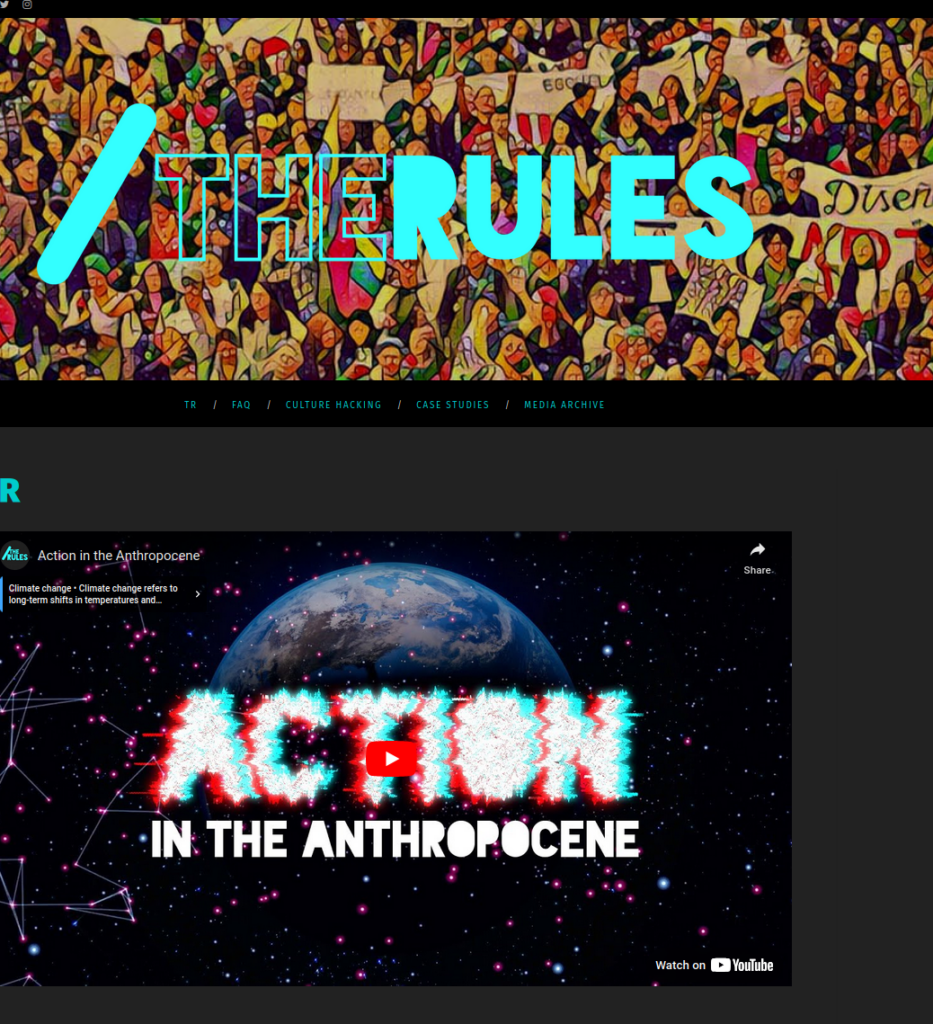
    As activist collective The Rules worked to put a bow on their efforts with meticulous archiving of all their resources, they decided to upload their open source “culture hacking” tools to public code-sharing site GitHub so that others could use and improve.

    The Rules gets bonus points for putting those tools up in a more public place than their website so they are protected against the possibility of their own website going down. Websites going down because of unpaid web hosting bills is a sad but true fact of nonprofit endings.

    …..and also remember to:

    • tell an expansive story – If possible, reach out to as many former stakeholders as possible. Explore how their voices can be included in the final story of the organization.
    • cease submissions – if you have been soliciting mailing list signups, donations or anything else. Please remove and disable all such buttons and forms. If you wish, you might encourage people to donate to partner organizations.
    • update all your channels -Don’t just update your website, please make sure your physical location, your voicemail, and all your social media channels make it clear that you are closed. Too often, I encounter organizations that have a decent tombstone site but still have Facebook pages or Instagram profiles that on first glance make it look like they are still active.
    • pay your bills and make a plan – This is a tricky one, but — if you can — pay to keep your website up for a meaningful, agreed-upon period of time before your bank accounts are closed. You will also want to decide whether you want to let it die after that or if you can find some other way for the most valuable/valued aspects to be preserved. Whatever you decide, make sure it is communicated!

    While this likely won’t be easy, when done with time and care, turning your site into a tribute to the work you did can be transformative and healing. As each team member contributes to finalizing the website, you can move closer to crafting a narrative that will be valuable to many in the future.

    If your organization needs support building your tombstone site or simply supporting you through a closure, don’t hesitate to reach out!

  • Signalling A Pause

    In talking to people on the hotline, I meet them where they are in their closing journey. While some of them are certain they are closing, others are entering a period of deep discernment around the future of the group. When I hear a large amount of uncertainty, I will often suggest that they consider the possibility of pausing operations.

    Pausing operations can give the organization time to:

    • give the staff, board, volunteers, members time to address symptoms and causes of burnout;
    • talk to funders about the situation;
    • connect with partners about your challenges; and
    • assess the impact of your organization’s (temporary) absence from the ecosystem.

    Examples of Responsible Pauses

    Over the years, I’ve collected a few examples of inspirational nonprofit pauses. Here are a few I really like.

    Allied Media Conference’s Year of Chrysalis

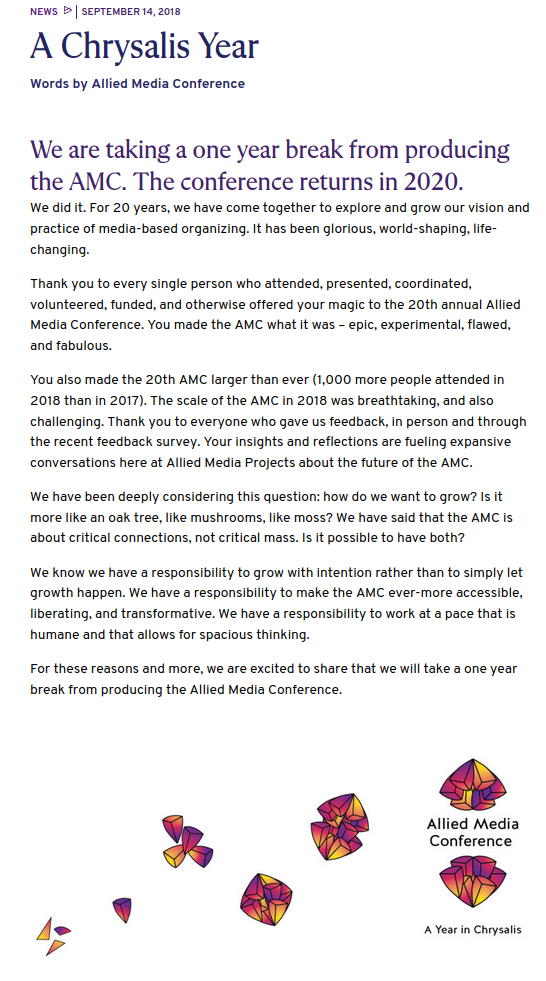
    In 2018, Allied Media Conference decided to take a year (2019) off to think about how they wanted to move forward after 20 years of operation. As part of the “chrysalis” period, they decided the conference would shift from annual to biannual. 2020 was the first virtual conference, with 2022 marking the final gathering.

    In 2023, the parent organization Allied Media Projects announced that the conference would be sunsetting.

    New Constellations’ Pause

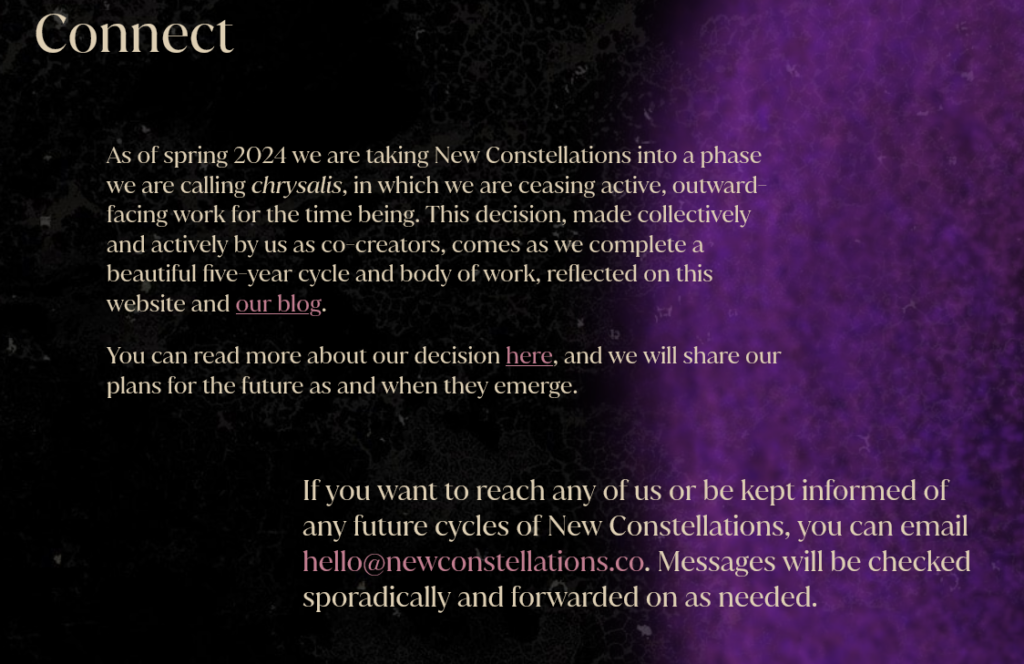
    New Constellations is a time-bound global initiative to support transformative community building. They announced their pause in 2024 after five years of operation.

    SAALT’s Year of Chrysalis

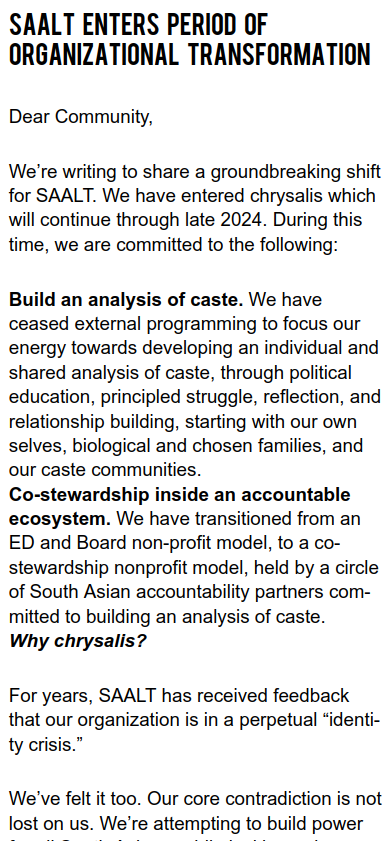
    South Asian Americans Leading Together (SAALT) announced a pause in late 2023. The group offers programs to support new immigrants, gather South Asian American leaders, and develop youth leadership. Their focus during this time of discernment is to try and tackle caste-ism in their ranks.

    Elements of A Responsible Pause

    While every pause is unique to the group and context, there are a few elements that make for a considered and successful pause period. Here are the aspects I have observed.

    Structure the Pause

    Determine Operations Level

    Before you declare that you are in an organizational pause, you will need to define what pause will actually mean for your group. It can vary depending on the size of your organizations and the nature of you current commitments.

    At Allied Media, their pause period did not mean bringing all operations to a stopping point. They operate as funders, facilitators, and fiscal sponsors, and that work needed to go on.

    In another case, a community nonprofit noted that a possible pause could mean simply letting the existing programs, which were in partnership with a local school, run through the end of the school year and then not renew for the coming school year.

    Your team will need to decide what can be stopped completely, keep running at a low hum, or remain functioning “as normal”.

    Plan Some Activities

    You will also need to develop arough outline of what you want to actually do during this time. Will you do a staff or board retreat? Will you have strategic board meetings?

    You should consider connecting with a facilitator to explore how they might hold space for your group to have these necessary tough discussions. While the executive director or board president may be the person that normally facilitates gatherings, bringing in outside help gives them the permission to put their energy into group in a new and necessary way.

    The pause is also a good time to consult with your funders and strategic partners. These people could have useful guidance for you, and in some cases, strategic partners might be able to help take over some of your programming or even be able to facilitate a merger or acquisition.

    Set A Timeline

    In addition to agreeing on how much to tune down operations and what you want to do during this time, you will also want to time-box your pause. It important to give yourself a reasonable deadline to make decisions. Aim to set a timeline that is sufficient to accomplish the tasks you laid out in the previous step with a little padding to accommodate the normal rhythms of life.

    Communicate the Pause

    Once you’ve determined the rough outlines of your pause, you need to let everyone know what is going on. In many communities, word travels fast so it’s important to make sure that internal people know fairly early on and don’t feel blindsided. You also need to communicate this shift to your fundraisers, your partners, and the greater public. Make sure to put a notice and explainer on your website and any social media your organization uses.

    Note: You don’t have to use the word “chrysalis”!

    Reporting Back

    During and after your break, sharing what is going on/ went on can help foster transparency and trust within your community and the larger ecosystem. The challenges your organization is facing are likely not unique to you, and the lessons you learn can offer up a path forward to others who are facing similar situations. Update your blog and social media to let everyone know what’s up!

    After Allied Media ended its chrysalis year, it shared its takeaways in several places, and it even cited conversations from the chrysalis year when they decided to transition their executive director two years later.

    Take Action

    Finally, after you’ve exited your own organization’s “cocoon”, it will be time to embark on actions to either spin back up operations to the new level, make staffing changes, articulate a new mission, or shift your focus to winding down operations. While you will have reported back via public channels, the same people who you communicated the pause to will also need to be informed of what the plan and direction will be moving forward.

    When Pausing Is Not The Answer

    While there is power in the pause, it is important to note that the pause is not a time of inaction, it is a time of active inventory and introspection. You will need to be available to meet, assess, brainstorm, and have deeply honest conversations about where you are now, how you got there, and possible paths forward.

    If you don’t have a critical core of people on board to do this, it might be a sign that a considered closure is a better way forward. Saying “paused” when you mean “closed” can cause confusion and engender mistrust amongst your funders, partners, and the community you serve.

    If there is only a little bit of gas left in the tank, I’ve found that it is better used to give the organization a respectful sunset. Using those final pushes to tie up loose ends, can ensure that you leave behind an honorable legacy and useful breadcrumbs for whoever picks up the work in the future.

    (For more on this topic, check out the article “Permission To Pause” by The (now-defunct) Whitman Institute)

  • Announcing the Closing Remarks Newsletter

    Hi friends! I started a newsletter. It’s called Closing Remarks and it’s gonna be a semi-regular (maybe twice a month?) roundup of links related to non-profit closures and the assumed connection between longevity and impact.

    You can see the first issue and sign up for it below or here.

  • A Good Day To Die: Some Reasons To Call It Quits

    One of the major goals of The Wind Down is to help shift the discourse around non-profit endings so that the immediate assumption isn’t that the organization or project closure is the result of loss or failure. Not only is it too often the case that outsiders hold this belief, sometimes people inside the organization are guilty of it too. People will dissuade themselves from even considering closing because things are “going well”.

    The truth of the matter is that there are all sorts of reasons for an organization to stop existing, and the more people know about them, witness them, or take part in them, the more they can (hopefully!) move away from a knee-jerk negative reaction to sunsets. Here are a few reasons I’ve come across along the way.

    SUCCESS!

    This might be my favorite closure reason. If an organization accomplished what they set out to accomplish and can neatly close down, what a win for everyone! One of my favorite examples of this is the We Charge Genocide campaign that ran from 2014-2016 in Chicago. Inspired by the 1951 We Charge Genocide petition to the United Nations, they were able to raise funds to send 8 young Chicagoans to Geneva to charge genocide against the United States for protracted police violence.

    Upon return they created an informative report and organized in their communities for a short time before slowly winding down in 2016. They came to charge genocide, they did, and then they stopped!

    Another fantastic example is the WaterSHED project, which was created as a 10-year initiative to help expand access to clean water in Cambodia. The goal from the outset was to support capacity-building on the ground and then leave. And despite many challenges , they left when they said they would. WIN! (Seriously, read former-ED Geoff Revell’s article about it. It’s so good.)

    SHAPE AND/OR PROXIMITY

    Social change work is not one size fits all. If the organization is too small or too big to do the work, it might be time to either change shape or shut down. In addition, sometimes an organization — or an organization’s headquarters — are too far away from where the service is needed or can best be delivered. One example that relates well to this is EveryChild’s closure.

    EveryChild was a UK international development charity formed in 2001 that operated field offices in Eastern Europe and the developing world. In 2011, the organization intiated a series of strategic changes that devolved power to local agencies and eventually resulted in the creation of a new international alliance, Family for Every Child. Thus the decision was taken to close EveryChild and all its field offices from the period between 2013 and 2016, and leave the work to the people who could more effectively make an impact in the lives of the children and families they wished to support.

    “Concerns about lack of sustainability may be financial (loss of funding or a growing cost base), a loss of key people (staff, volunteers or trustees), a lack of shared direction, recognition that others doing similar things, there are duplications or inefficiencies, or a growing concern that your work is no longer viable or relevant in a changing wider context.”

    Sensing An Ending: A Toolkit for Nonprofit Leaders to help decide, design and deliver better organisational endings by the Stewarding Loss Collective

    OBSOLESCENCE

    Adjacent (and maybe overlapping?) with success is the idea that the organization just isn’t needed or won’t work anymore. Many initiatives and groups in the civil society space are started with the humble vision of “working themselves out of a job”. Sometimes this happens! And then sometimes the situation on the ground just changes. In this 1999 Guardian article, the writers outline how war in former Yugoslavia quickly put an end to a flourishing network of NGOs committed to growing civic society in the wake of political change. In the blink of an eye, the terrain changed and the groups could no longer function as the vision of a free and flowering Yugoslavia was no longer viable.

    LEADERSHIP

    Many organizations grow out of the vision of a single inspired leader or group of leaders. Oftentimes when a founder or team of founders decide to step away, they can leave shoes entirely too big to fill. Sometimes it isn’t necessarily the founder, but just a really strong leader who the board struggles or is unable to replace. Stories of such transitions can be found on Naomi Hattaway’s excellent Leaving Well podcast.

    DISCHORD

    So now we are getting into some of the stickier ones. Organizational dischord is certainly at the heart of some pretty epic closures. Conflicts and the inability to functionally tackle them are a big part of what led me to start asking whether these endings could happen better than I’d seen them happen.

    One well-documented and notable example of such an ending was UK-charity Campaign Bootcamp’s sunset, which was sparked by difficult and, ultimately, irreconcilable issues around race, class, privilege and power. Campaign Bootcamp, an organization that had been a darling of the UK charity sector was formed to support people in gaining the skills they needed to launch successful campaigns for social change. However, when the change that needed to happen was “inside the house”, the leadership was unable to reach an equitable and just resolution.

    MONEY

    Lack of funds is very often a reason that an NGO will shutter its doors. Whether it is a lack of foundation funds, money from individual donors, or tuition related to enrollment (a challenge facing many US universities as of late), cash-strapped organizations struggle to meet the needs of their employees, partners, and the communities they aim to serve. Low funds and inability to cover costs are extremely valid reasons to close up shop.

    In a future post, I plan to cover how this sort of ending might be managed, particularly from a fundraising and fundraiser’s perspective.

    STAFF

    An organization is only as good as its people and if you can’t hire and retain capable people to do the work, you will struggle to fulfill your mission and realize your vision. Non-profit staff members are frequently overworked, underpaid, and highly prone to burnout. While many non-profits profess lofty values of care, far too often they fail to realize them in their employment practices.

    Even when your organization does offer great benefits and a manageable workload, competition for talented workers can be challenging when competing with opportunities in government and private sector. If your group or initiative can’t offer the sort of salaries and/or job security those others can you may struggle to hire the people you need, attract good volunteers, and/or build the capacity to drive forward your mission.


    This by no means an exhaustive list. What other reasons have you seen for NGOs to die? Lemme know in the comments!

  • What To Say (And Not Say!) When A Person Is Going Through A Non-Profit Closure

    Though closures of projects in the civil society/non-profit space are nothing new, it still can be a bit tricky to know how to be supportive and show empathy when someone is going through this life-changing experience. A few friends of mine recently went through personal tragedies and as I was thinking about how best to be there for them I got to thinking about how we might show up better for people going through organizational endings.

    Some Less-Than-Helpful Personas


    THE DETECTIVE

    People often assume an organizational closure is the result of some big failure , blowup, or catastrophe. The thinking is often that there is some salacious story or else some agonizing tale of woe that caused the organization to come crashing down. However, the truth is that lots of groups close for mundane reasons and some even close intentionally and triumphantly (see the story of WaterSHED’s closing as one example).

    Rather than getting into the details of the organization, why not meet your friend where they are and check into what is coming up for them. Do they have any immediate needs that you can assist with? Are there any milestones coming up where you might be able to check in with them? Mark your calendar and set reminders to be there for your friend and colleague when and where they actually need you.

    THE NEWSHOUND

    The non-profit funding landscape is tricky and getting trickier every day, but you know who likely knows that best? Your friends working at non-profits. Bringing up articles you read about how things in their industry or area of focus are “particularly bad”, is not really going to be useful when they are already face to face with the end.

    Part of what lead to the organization’s demise is likely to be related to lack of support from funders and other stakeholders and was often painfully out of their control. Mentioning macro trends when someone is facing an urgent and acute issue smacks of blaming the victim.

    THE CONSOLER

    NGOs close in so many ways and for so many reasons. In the short time, I have been talking to people about these endings, I have heard stories ranging from the disastrous to the positively jubilant. So when you hear someone’s organization is closing, you don’t need to immediately need to go into condolence mode. Even in the disaster situations there may be people who are excited and eager to move in, and, similarly, even a well-planned, intentional program or project end can have its rough edges. When faced with news of a shutdown, be neutral, polite, and curious.

    THE SILVER LINER

    An organizational closure can bring up a lot of emotions, even when the ending is mostly positive. So it is better not to try and put a “silver lining” on it. Mentioning to the person going through the organization closure that at least they “won’t have to deal with [INSERT ANNOYING COWORKER NAME HERE} anymore” is not particularly helpful. If they bring it up, it is fine to agree with them, but it’s not the most helpful thing to try to put a positive spin on the situation if your friend is not feeling particularly positive about it.

    THE POLLYANNA

    Similarly, you don’t have to try and reassure the person that something better is going to come along. Life is long and mysterious and we don’t know what is going to come next. While it is good to be supportive and hopeful about the future, if the person you are dealing with doesn’t feel like anything good is on the horizon, allow them the space to sit with that feeling rather than trying to divert them because you are uncomfortable with the situation.

    If you find you aren’t able to hold space for the big feelings that your friend is holding, you can certainly send this website along to your friend and let them know I also offer free closure calls to people closing or in discernment around closures. I’ve been through it, and I am happy to be a listening pair of ears!

    Some Helpful Personas

    THE GRATEFUL

    The person or people who are facing down the end are likely struggling with feelings of regret about what they didn’t do or grief for the dreams and goals they weren’t able to achieve. Whether they were part of the founding team or a later addition, people who often pay the “passion tax” to join a mission-driven organization are looking to come away with a feeling that they are making a genuine impact on the planet. When their organization must close — usually due to no fault of an individual employee — that sense of purpose is abruptly wrenched from them.

    Why not be the one who reminds them of all the good they were able to achieve during their time in operation? Thank them for their service and remind them that, no matter how long they existed, they did make a valuable contribution. When possible, find examples of other people thanking them for their work and let them know there is likely still more time for them to be of service on the planet.

    THE HELPFUL

    The ending of any type of project or enterprise is full of various loose ends (no pun intended!) that need to be tied-up. As the final days of an organization draw near, it is often the case that there are fewer and fewer people around to sort out the crucial tasks necessary to completely close out. Why not offer a helping hand? Even if there is nothing specific for you to do, sometimes just being present and bearing witness is enough.

    Worries for the future coupled with sadness about the past and present can easily cloud the mind and make it hard for your friends facing closure to focus. Sometimes just being a body double is enough to lift people’s spirits, shake feelings of isolation, and assist in getting them on track.

    Alternatively, your friend/colleague may just want someone to distract them from what is going on. Whether that person is generally relieved or even happy the organization is closing or if they are feeling woeful, they may find that the work of shuttering the organization is just occupying too much of their mental space. Take them out for a drink or invite them to a movie to get their mind off work.

    THE EMPATHETIC

    Finally, if you’ve been through a closure of your own, do share about it. So many organizations shutter every year (see our Museum of Closed NGOs for some!), and the more we talk about these organizational endings, the more we can normalize the idea that nothing lasts forever and good things can come from people gently releasing their work back into the wilds.

    In addition to the free hotline I offer, I also have some self-assessment questions that I suggest people go through with a friend or colleague. You can be that friend or colleague!