November 2025 – Life Cycles, Loss, and Leadership: Designing Regenerative Futures In The Arts with Jillian Eileen Harris
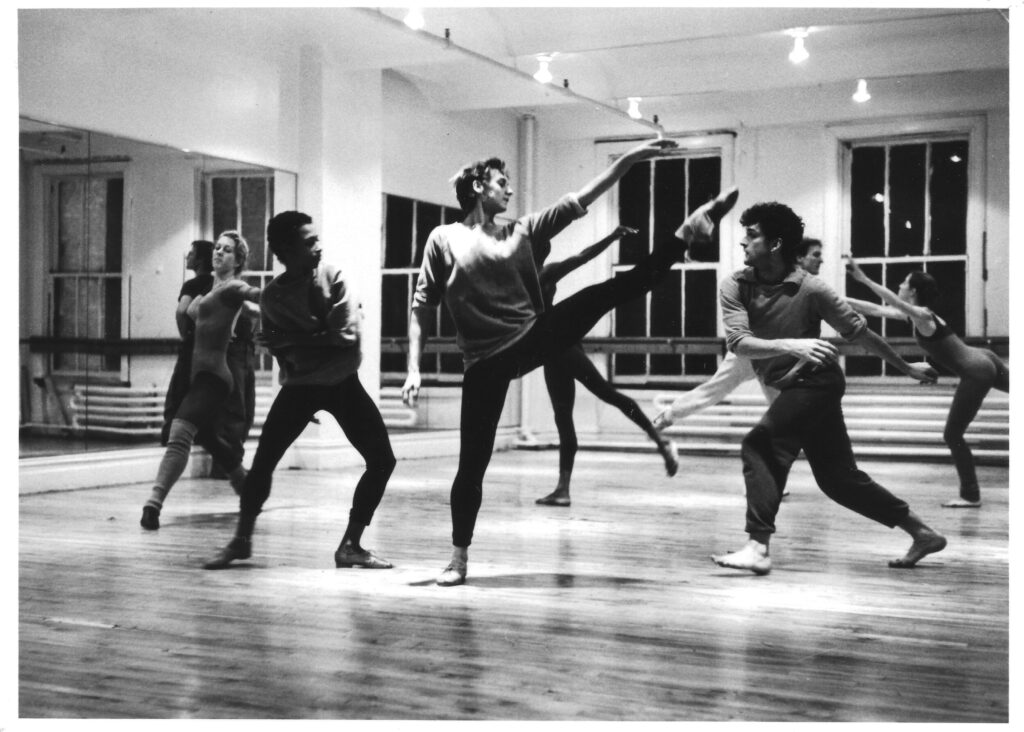
For our final speaker session (for the foreseeable future), we were joined by the lovely Jillian Eileen Harris, who presented on her academic work on life cycles in theater and musical arts in Canada. She started by sharing that her inquiries were rooted in her own “unfinished business” around endings in her personal creative pursuits. She said, “I didn’t want to study (endings), but my heart lead me in this direction.”
Following Her Heart To The Ends
A professional actor and theater maker, Harris spent seven years as part of the Montreal-based CABAL Theatre Company. She spoke to the group about the grief of working through conflict and closure in this organization. She characterized the lifecycle of the organization, which attempted to weather the storms of the COVID lockdown, as somewhat painful with a lot of discord and isolation.
After the company closed and Jillian moved forward to pursue a masters degree in design, strategic forethought, and innovation, he she was given occasion to interrogate what she’d gone through…and how it might have gone better. In learning about systems change, degrowth, and regenerative design as part of her studies, she realized there were frameworks available to help her further decode what she’d experienced. She realized she needed to dig deeper.
“What if closure was actually seen as success? What kind of structures, mindsets, and leadership practices would that entail?”
Over the 8 months of her research, she interviewed 11 practitioners across Canada and US, exploring how orgs worked through change and endings. She counted over 180 closures across Canada, and learned that she hadn’t been alone after all. Across North America, she found that performing arts groups were on the ropes, facing issues like declining audience participation and reduced public funding.
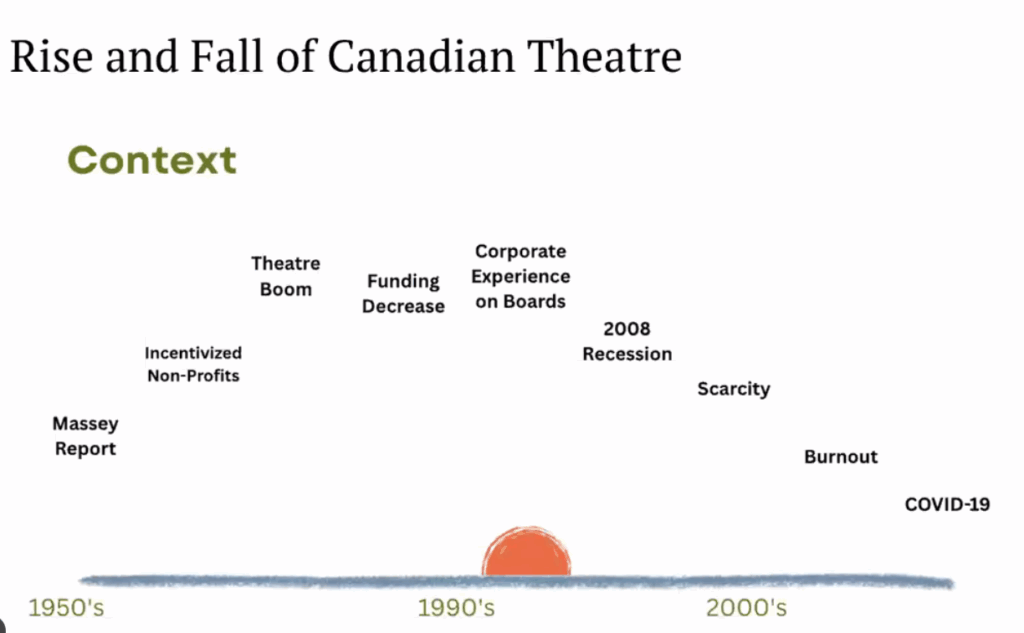
Jillian says she also feels it is important to be honest about how Eurocentric and colonial the project of Canadian theater has been, not everything needs to be preserved and survive. Nonetheless, she found that Canadians were often exceedingly proud to have theaters in their cities, and, despite the fact that they were often expensive to run and difficult to fill, there was a sentimental attachment that made community members resistant to change and/or endings.
Mapping Across The Horizons
The Three Horizons Framework is a tool developed by McKinsey consulting company that is used by leaders across business, nonprofits, and the arts to way-find and innovate. The first horizon (H1) is the currently dominant but failing system that declines over time as it loses its fit with a changing environment, the second horizon (H2) is an innovative and turbulent time, hopefully bringing forth the desired and better future represented by the third horizon (H3).
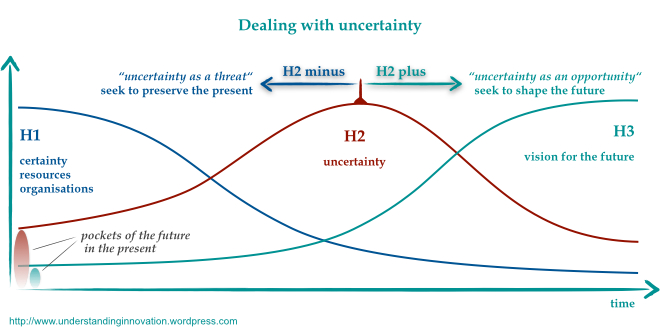
Jillian used this framework to map where she believed many embattled performing arts often found themselves. Too often they failed to get far beyond that first horizon. In working with her advisor, she was encourage and felt called to draw out aspirational,”horizon 3″ types of visions. Her guiding question was, “What is the future we are dreaming into?”
In a visionary turn, she used what she gleaned from the interviews to produce not only her research report but also a creative piece A Commons In Bloom, which featured a monologue and also a letter from various fictional theater makers living in the year 2053. In that piece of speculative fiction, theater companies were now “swells”, time-limited collectives producing innovative works and then necessarily falling away for what will come next.
The Power of A Final Act
Jillian believes that theater makers are uniquely equipped to facilitate great endings. They are storytellers and know how to hold space and move through tragedy. They also have the ability to imagine and incarnate worlds that don’t yet exist.
She also spoke about the importance of cycles and rituals in arts organizations. She believes that ritual is a language that we all speak even if we don’t realize it. Rituals mark time and gather people around what is changing. As such, artistic ritual holders can use the space not only to entertain, but also to lend educate and lend critical support to those struggling in times of transition.
Thanks again to Jillian for a riveting session!