I love borrowing concepts from other fields to help think and/or explain challenges in closure. One I love Is the idea of scuttling, a term from the maritime domain that refers to the process of deliberately drowning a ship or running it aground in order to address a specific problem. Ships get scuttled for several reasons, sometimes it is to make a quick escape in a dangerous situation, in other times it is to create an artificial reef or clear navigation channels for other vessels.
So given my nerdy love and use of that nautical expression, I was excited to turn on the radio the other day and learn another one: fouling. Fouling occurs when a vessel sits idle for too long and begins to amass barnacles, algae,and other organisms on the ship’s body, which then causes it drag and damage. It turns out this sort of fouling is happening at this very moment to hundreds of ships that are currently just sitting and waiting in the Strait of Hormuz. Not only is there an effect to the body of the ships, there is also the psychological harm being inflicted on all the seamen sitting with uncertainty about whether and when they will get home as they wait for the resolution of a conflict they didn’t start and are powerless to influence.
All this got me thinking about the long-term effects of uncertainty in the social sector. Of course, not every minute of the day can be capital-D Doing the work but I do wonder what might be deleterious effects having to pump the brakes to deal with financial and political crises. Among the questions swimming around in my mind are: How much wear and tear does it put on the battered body of a busy org and its overworked staff? Is there any way to do some amount of preventative anti-fouling (this is a real thing!)in anticipation of these times? How do continued periods of such fouling factor in to the calculation of any individual employee’s tenure or even the anticipated lifespan of an organization?
Here are this week’s links:
1) Priced out prison guards cause clinker closure
2) Name mixup muddles a foundation’s wind down
When The Dorot Foundation announced its ten-year spend down plan last month, phones began ringing off the hook…..at the anti-loneliness nonprofit also called Dorot (which means “generations” in Hebrew). Despite announcements from the foundation explicitly explaining that the two organizations had “no connection”, the confusion persisted, going so far as donors and funders of the non-foundation Dorot threatening to pull funding due to the perceived spend out!
I spend a lot of time thinking about closure communications but cases of mistaken identity wasn’t on my BINGO card before reading this one…but it is now!
3) Unfortunate faltering of AZ domestic violence hotline
Despite growing rates of domestic violence in Arizona and a persistent need for support services, Phoenix’s SafeDVS was forced to abandon this vulnerable population and close its lifesaving phone line earlier this month. For about 15 years, this 24/7/365 call center operated a centralized referral system for all domestic violence shelters in Maricopa According to another local leader in this space, victims will now have to resort to calling shelters one by one to find a safe haven.
4) Failed building bid bests Boston black business space
For over a decade, Roxbury’s Black Market incubated new projects and hosted vendors and community events to stimulate the economy and foster self-empowerment in the Nubian Square area of this vibrant urban neighborhood. Unfortunately, after a deal to buy their building fell through, organizers declined to sign a lease extension with the building owner (itself a nonprofit) choosing instead to end the effort altogether.
Organizers are now scrambling to vacate the premises, wrap up programs, and help current vendors secure new homes. Community advocates and planners say the episode highlights the broader challenge of turning cultural programming into sustained ownership in rapidly gentrifying neighborhoods.
5) Quaker-based education on the ropes in New England
Since 1961, Cambridge Friends School has provided elementary and middle school education rooted in the Quaker religious tradition to young people in the Cambridge area of Massachusetts. However, an email that went out earlier this month advised that the 2026/27 school year will be its last.
Though no reason was provided, records reveal that enrollment at the school, which serves a high percentage of working class and students of color, has nosedived from 145 in 2023 to just 23 in the 2025/26 school year. School trustees says they will use the time after the final school year to explore options for continuing to promote Quaker education in the region.
“…grief is an inevitable part of life and is widely present in philanthropy and wealth distribution…a healthier philanthropic ecosystem would require us to get better at recognising it, naming it, and tending to it.”
A great piece by the always-fantastic Louise Armstrong, who is the executive director at Thirty Percy Foundation and co-founder of UK closure firm The Decelerator.
7) Passing the Torch: What It Means to Transition with Care
“And while the headlines often focus on who’s leaving or what’s being lost, I’m starting to believe that change doesn’t have to feel like loss. It can also be an act of love if we approach them with care.”
Sometimes I get so annoyed with LinkedIn that I wanna just delete my account and never go on there again and then other times, I come across ideas and people so invigorating that I remember why I am there. Miriam Messinger recently crossed my path on LinkedIn and reading this article that she co-wrote when she was at Interaction Institute for Social Change last year really made my day!
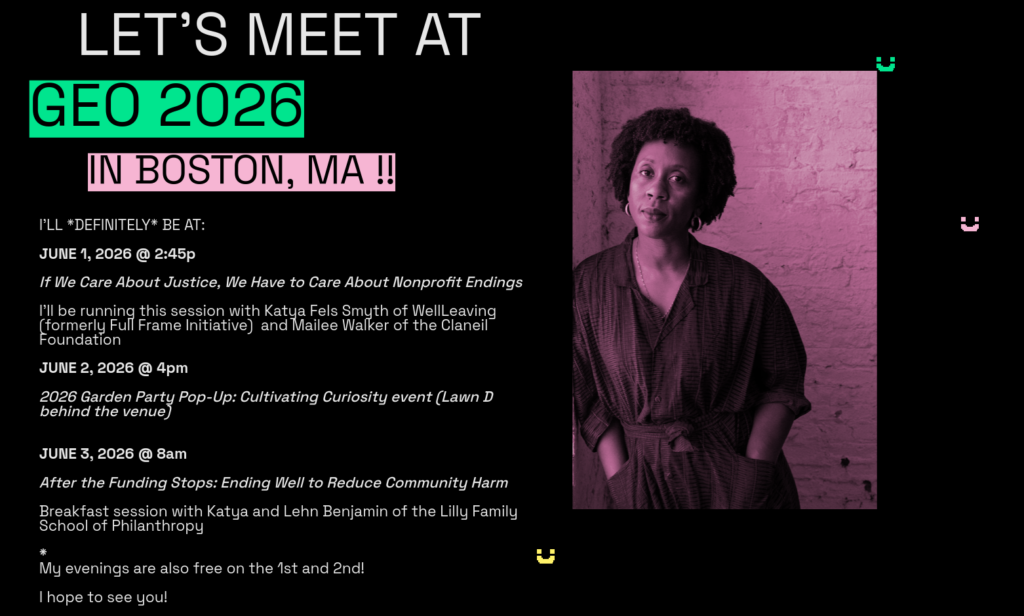
THIS WEEK! THIS WEEK! THIS WEEK!
Leave a Reply